Cosmetic packaging · Made for your brand
EU Fragrance Allergens 2026: Cosmetic Packaging Artwork
Plan cosmetic artwork for EU fragrance allergen labelling: check formula data, finished-product thresholds, transition dates, refill labels and physical proofs.
Containers only — no compounding or filling.
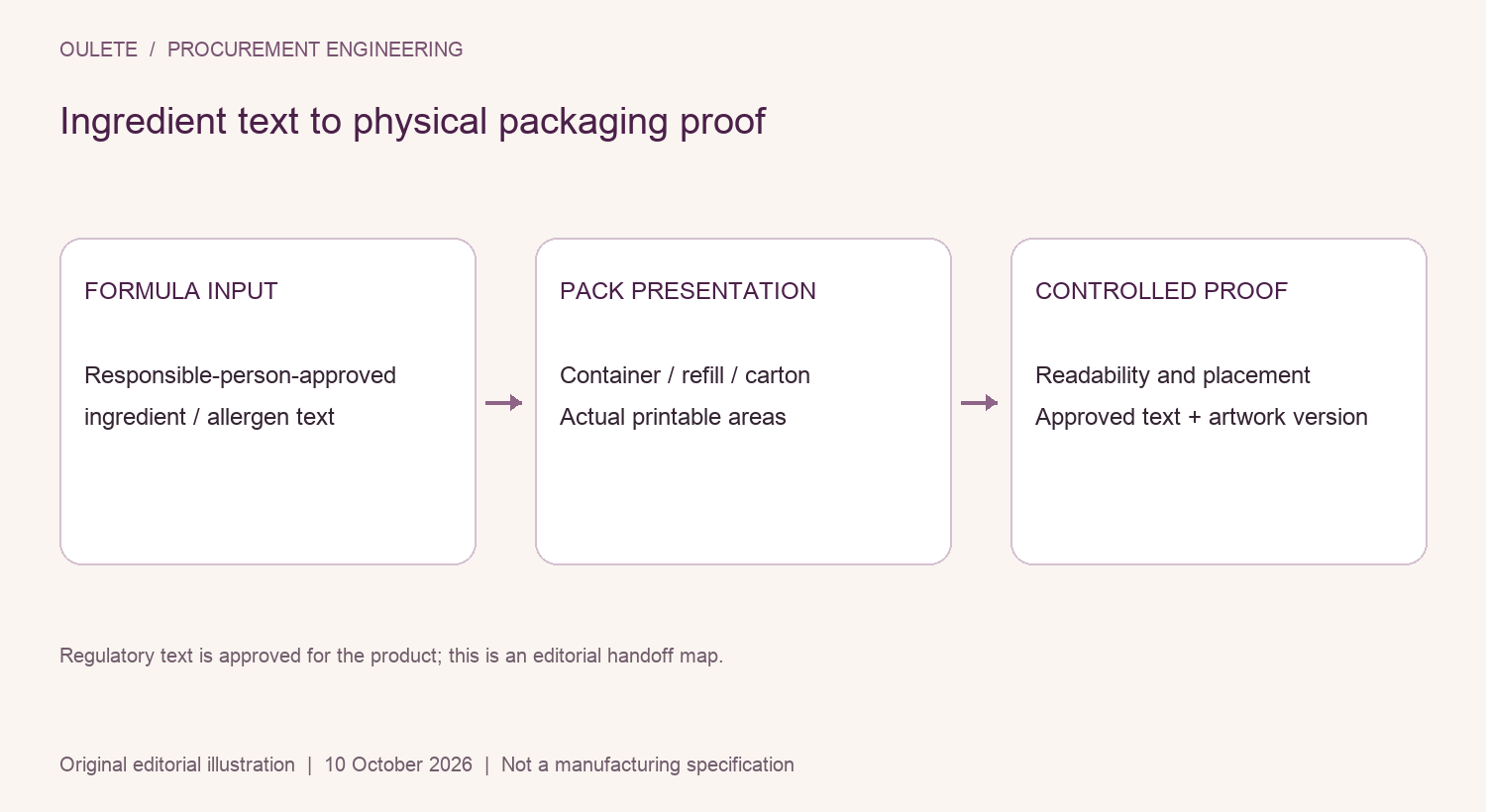
Ingredient text to physical packaging proof showing formula input, pack presentation, controlled proof
On this page · 13 sections
- EU fragrance allergen labelling in 2026: the decision points
- Calculate the finished formula before changing the artwork
- Hypothetical calculation, not a customer formula
- Allocate ingredient text across jars, refills and outer packs
- Keep the approved ingredient list intact in a small print area
- Freeze formula, text and packaging versions together
- FAQ: expanded fragrance allergens and cosmetic labels
- Must every cosmetic package print 80-plus allergen names?
- Are the thresholds measured in the fragrance concentrate?
- Is the 2028 date an extension for every older product?
- Must the full ingredient list always appear on the bottle?
- Can a QR code replace an ingredient list that will not fit?
- Can a bottle factory supply the final allergen label text?
EU fragrance allergen labelling in 2026 starts with the finished formula; the approved ingredient text must then be allocated to the actual packaging presentation.
An expanded allergen review can change the ingredient list after a cream jar, refill or travel bottle has already been designed. The packaging problem is specific: the approved text must fit a defined physical presentation and remain readable, while the artwork, formula and ordered components stay under the same revision control.
This guide connects the regulatory inputs to packaging approval. Sources were checked on 10 October 2026, including the current Commission topic page and the November 2025 corrigendum. The formula owner and EU responsible person must approve the product-specific text and market assessment; a packaging partner can provide print-area information and physical proofs against that approved text.
EU fragrance allergen labelling in 2026: the decision points
The European Commission describes individual labelling for 56 additional fragrance allergens under Regulation (EU) 2023/1545. Names depend on the finished formula and applicable Annex III entries, including groups. “80-plus allergens” is not a universal print list. Current Commission guidance.
| Regulatory point | Verified rule or date | Packaging approval question |
|---|---|---|
| Leave-on product | Relevant individual labelling when concentration exceeds 0.001%, equivalent to 10 ppm | Has the formula team approved the required names for this presentation? |
| Rinse-off product | Relevant individual labelling when concentration exceeds 0.01%, equivalent to 100 ppm | Is the product classification recorded rather than inferred from its bottle? |
| Transitional placement | Qualifying non-updated products could be placed on the Union market until 31 July 2026 | Does the responsible person have the appropriate product and placement evidence? |
| Transitional availability | Qualifying products may remain available until 31 July 2028 | Does this particular supply qualify under the applicable conditions? |
The thresholds and transitional provisions come from Regulation 2023/1545. The first date has passed as of this guide's review date. The later date is not a blanket extension for every new batch of an older SKU. Qualification includes the applicable prior-compliance conditions; a manufacturing date alone is insufficient evidence of placement before the cutoff.
For packaging purchasing, record the responsible person's decision rather than selecting a deadline from the brand's launch year. Identify the formula version, stock concerned, destination market and evidence reference. A long-running product name can appear on different batches and packaging revisions. That name is useful for sales, but it cannot replace a documented release decision.
Allergen labelling is one input to the ingredient text. It does not establish overall formula safety or approve contact materials. Artwork should use the text approved for the actual product.
Use the amending regulation together with its corrections. The 2025 corrigendum, published on 11 November 2025, corrects entries 157, 364 and 365. For example, entry 365 adds Pogostemon Cablin Leaf Oil to the common-name information. A pre-correction spreadsheet needs regulatory review, not automatic reuse as the artwork source.
For the packaging handoff, request the approved ingredient text and the regulatory version reference used to produce it. Record whether an updated name review changes the printed text. The printer should receive the resulting controlled file; it should not independently choose a substitute name from a search result or raw-material invoice.
Calculate the finished formula before changing the artwork
The relevant concentration is the allergen contribution in the finished cosmetic product, not simply its percentage in a fragrance concentrate. The formulator needs current, suitably detailed information for the supplied fragrance and other relevant raw materials. A declaration that omits the expanded review cannot be treated as proof that the missing substances are absent.
A raw-material declaration records specified information about a supplied ingredient or mixture. It is an input to the finished-formula assessment, not a ready-to-print ingredient list. Match it to the supplier, material code and revision used in the formula. A declaration for a similar fragrance name or an earlier version can leave the calculation attached to the wrong material.
Ask the formula team to use a common concentration basis throughout the calculation. If quantities are expressed on different bases, resolve the conversion before applying a threshold. Preserve the underlying values and their precision so an early rounded display value does not become the sole basis for deciding whether a name belongs on the label.
Hypothetical calculation, not a customer formula
Suppose a fragrance is used at 2% by weight in a finished product, and the relevant allergen is 0.2% by weight of that fragrance. The contribution from this source is:
2 × 0.2 ÷ 100 = 0.004% in the finished product = 40 ppm
This source alone contributes more than the 10 ppm leave-on labelling threshold. It contributes less than the 100 ppm rinse-off threshold, but that is not a final rinse-off decision: the same relevant substance may also come from other ingredients. Add the applicable contributions and resolve the Annex III naming or grouping requirement before approving the text.
This is arithmetic using hypothetical values, not a customer formula, Oulete test result or safety conclusion. The brand's controlled finished-formula assessment remains the artwork input.
| Calculation input or output | Record to retain |
|---|---|
| Finished formula | Product reference, revision and relevant ingredient inclusion levels |
| Source materials | Supplier codes, declaration revisions and the concentration basis supplied |
| Combined contribution | Contributions from applicable sources and the calculation reference |
| Label naming | Approved common name and relevant grouped-entry treatment |
| Artwork input | Approved final ingredient text with its formula and market references |
The formula and regulatory team should complete this record before the packaging supplier resizes an ingredient panel. Otherwise, a layout can be approved using text that changes when the declarations arrive. The useful handoff is one approved text version with its decision owner, rather than a series of tentative lists in email attachments.
Allocate ingredient text across jars, refills and outer packs
Article 19(1)(g) permits the ingredient list on the packaging alone. This does not remove the other container and packaging information requirements. Article 19(2) sets out physical-information alternatives where practical impossibility applies, including an enclosed or attached leaflet, label, tape, tag or card. A QR link is not a general listed replacement. Cosmetics Regulation, Article 19.
The buyer's task is to map the approved information to the presentation actually sold. Review the initial pack, any independently supplied refill and the travel version separately. A reusable glass jar with a branded outer carton is one presentation. A replacement cup delivered in a different format may need a different allocation decision from the responsible person.
| Packaging presentation | Information needed for the layout review | Question to settle before decoration |
|---|---|---|
| Initial cream jar and outer pack | All supplied components and approved text allocations | Which surface carries each approved information block? |
| Separately sold refill | Refill supply format, closure and accompanying physical packaging | Does the refill's own presentation carry the required information? |
| Small travel pack | Actual dimensions, closures, label areas and secondary packaging | Can the approved information be presented legibly in this format? |
| Proposed physical alternative | Selected leaflet, label, tag or other approved arrangement | Has the responsible person approved the route and its required references? |
Confirm the components supplied with each sale: initial set, refill alone or travel format. A carton visible in a concept image is not proof that the channel supplies it.
For a magnetic cream jar, identify whether the outer lid is retained by the consumer while the filled refill changes. The physical design affects where information can remain visible and which elements travel with a replacement. This is a packaging review question; it does not establish that a particular magnetic jar or refill has already been approved.
For a dual-ended travel pack, review the body, both caps and any outer package as one marketed presentation. Decide where the information blocks fit without being interrupted by a joining seam, removable part or highly curved end. Do not infer a product's regulatory class or formula composition from the presence of a roll-on or mist applicator.
The refillable packaging and travel-size packaging pages can support format selection. The final allocation still needs the real component drawings and supply arrangement. Keep the resulting label plan with the approved packaging specification so a later carton or refill change reopens the correct review.
Keep the approved ingredient list intact in a small print area
A small cosmetic packaging INCI label should be laid out from approved text and the actual printable area. INCI means International Nomenclature of Cosmetic Ingredients; the approved ingredient naming still needs the applicable regulatory review. The designer should not replace a required name with an abbreviation simply to recover space.
Begin with a controlled dieline, the drawing that defines the label or artwork shape and its relevant boundaries. For direct decoration, obtain the proposed print area on the actual component. Distinguish the visible exterior from the area the selected printing process can use. A bottle's maximum diameter or height is not its available ingredient-panel size.
Allocate space before polishing the front-panel design. Put the approved information blocks, coding location and artwork boundaries into the working file, then review their relationship to the brand graphics. If the text will not fit, raise a design or presentation decision. Do not silently remove a name, shrink the text beyond usable legibility, or transfer it to an unapproved digital-only destination.
Article 19 calls for indelible, easily legible and visible lettering; it does not supply a general fixed cosmetic font size to copy from food-label rules. The proposed size and presentation need a physical review. Where an alternative information route is proposed because of practical impossibility, the responsible person should approve its applicability. Article 19.
Review the proof at finished size on the proposed surface. Pale ink on matte glass, a reflective cap and a curved refill present different reading conditions. An enlarged PDF supports text comparison; it cannot show the finished curvature or reflection.
Confirm that the decoration route supports the content, not just the front logo. The screen-printing versus hot-stamping comparison can help the discussion, but artwork detail and the selected substrate require their own proof. A process chosen for a decorative accent is not automatically suitable for a dense ingredient panel.
Record text accuracy and physical appearance as separate approval results. The brand should compare the proof with the approved ingredient text; the packaging team should compare its placement and finish with the agreed physical reference. Where handling durability matters, use a defined assessment tied to the actual decoration rather than inventing an abrasion pass from a photograph.
The decoration durability approval guide supports that distinction. Keep the agreed conditions, reference sample and decision together. A printer's confirmation that a file can be produced is not the same as the brand accepting the readable, correctly worded physical presentation for supply.
Freeze formula, text and packaging versions together
An artwork release should identify the formula version, approved ingredient text and packaging drawing revision that it implements. These references prevent a supplier from printing an obsolete file that still carries the correct product name. The approval record should also identify the person or team responsible for each decision.
| Release input | Proposed owner | Evidence attached to approval |
|---|---|---|
| Finished-formula assessment and applicable names | Formulator and regulatory team | Controlled formula and assessment reference |
| Market and product-specific label decision | EU responsible person and brand | Approved final text and presentation decision |
| Print area and process | Packaging and decoration suppliers | Dieline or print-area revision and supplied component reference |
| Text and visual proof | Brand with the responsible review teams | Final-size artwork and physical proof decision |
| Ordered supply | Buyer, filler and packaging partner | Quantity by version, assembly and packaging scope |
Use the table as a proposed handoff, not as a completed approval or an assertion that every company divides roles this way. Assign the real owners for the project. A buyer who commissions a contract filler should confirm who supplies the final regulatory text and who authorises the decorated-component order before either party releases production.
A formula or fragrance-source change reopens text assessment; a component change can reopen print-area approval. A regulatory correction can reopen the naming review without a formulation change. Record the trigger and decision owner so an unchanged marketing name does not conceal a changed artwork input.
Keep approved text separate from the layout file. Compare revisions character by character against that source, then review line breaks, surface placement and final-size readability. Identify obsolete files and segregate decorated stock by artwork version so a reorder cannot silently mix old and new ingredient panels.
For an Oulete artwork discussion, send the approved ingredient text, actual component layouts, refill sales format and proposed decoration route. The decoration page is the relevant entry point for checking the physical print proposal. Formula-specific calculations and legal text approval remain with the responsible brand and regulatory teams.
Before releasing a reorder, check whether the formula, declarations, approved text, print area or supplied presentation have changed. The reorder change-control guide provides the wider ordering framework. The practical outcome is a traceable artwork instruction tied to the intended supply, without treating an earlier proof approval as permanent permission to print every later version.
FAQ: expanded fragrance allergens and cosmetic labels
Must every cosmetic package print 80-plus allergen names?
The ingredient list must reflect the applicable assessment of the actual finished formula. An expanded reference list is not a universal list to print. The responsible team must resolve the relevant Annex III entries and approved names.
Are the thresholds measured in the fragrance concentrate?
The labelling assessment uses the relevant concentration in the finished cosmetic product. The fragrance declaration is an input to that calculation. Other ingredient contributions and applicable naming or grouping must also be considered.
Is the 2028 date an extension for every older product?
The 2028 availability date applies to qualifying products under the transitional conditions. It is not a general extension for new supply of every SKU launched earlier. The responsible person must determine the relevant status and evidence.
Must the full ingredient list always appear on the bottle?
Article 19(1)(g) allows the ingredient list on the packaging alone. Other required information and the actual supplied presentation still need review. A separately sold refill cannot be assessed solely by looking at the original jar's layout.
Can a QR code replace an ingredient list that will not fit?
A QR code is not a general ingredient-list replacement listed in Article 19(2). Where practical impossibility applies, the responsible team should assess the specified physical alternatives and their required references against the actual presentation.
Can a bottle factory supply the final allergen label text?
A bottle supplier cannot determine the final allergen text from the package appearance. The formula and regulatory teams approve that text. The packaging partner provides print-area information and proofs against the approved version, with any layout problems returned for a documented decision.
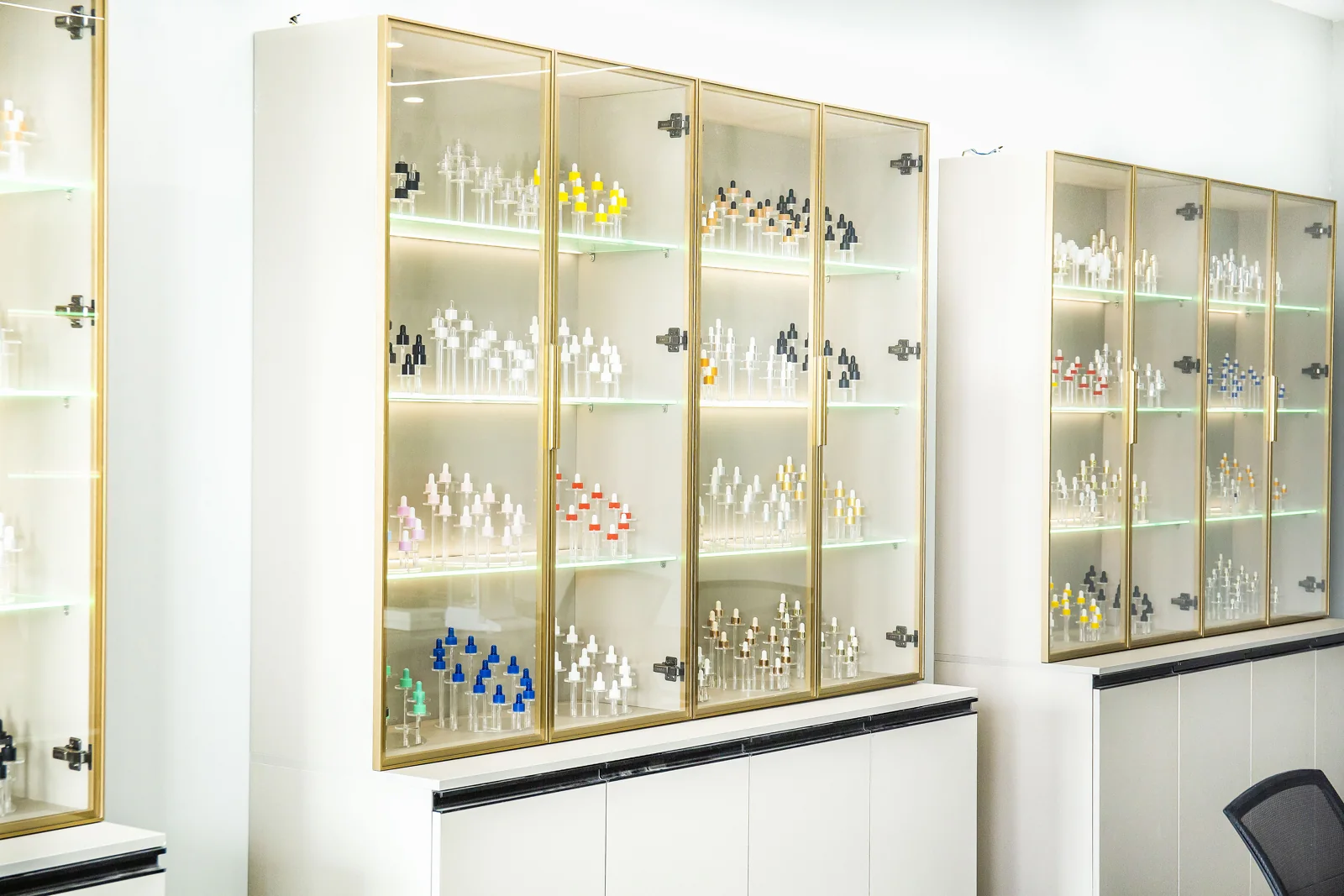
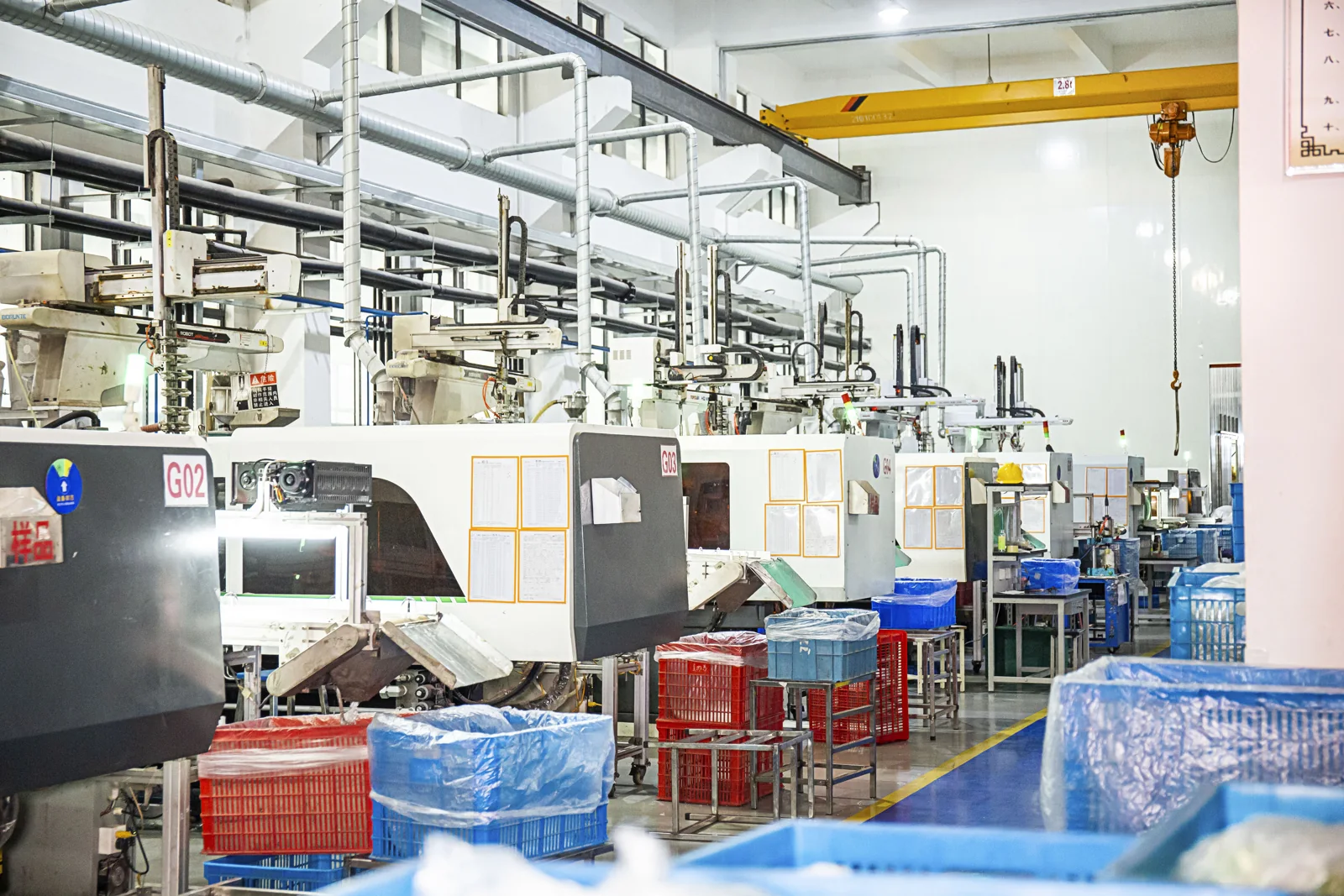
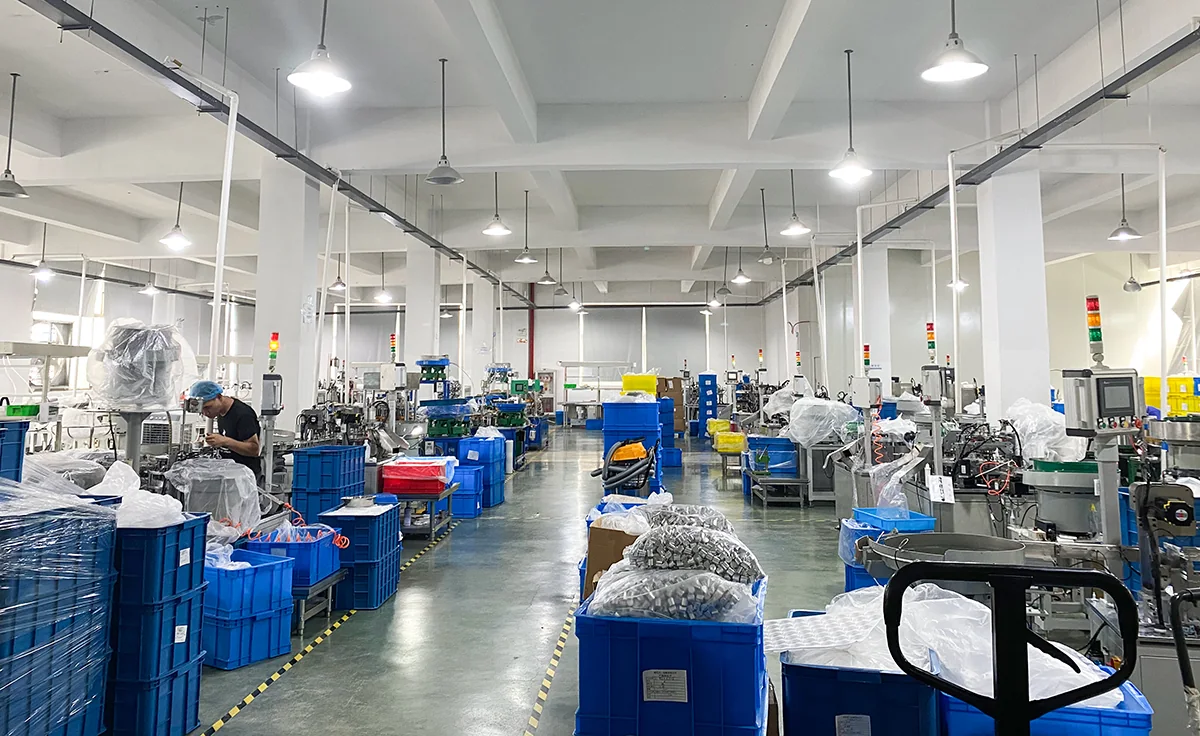
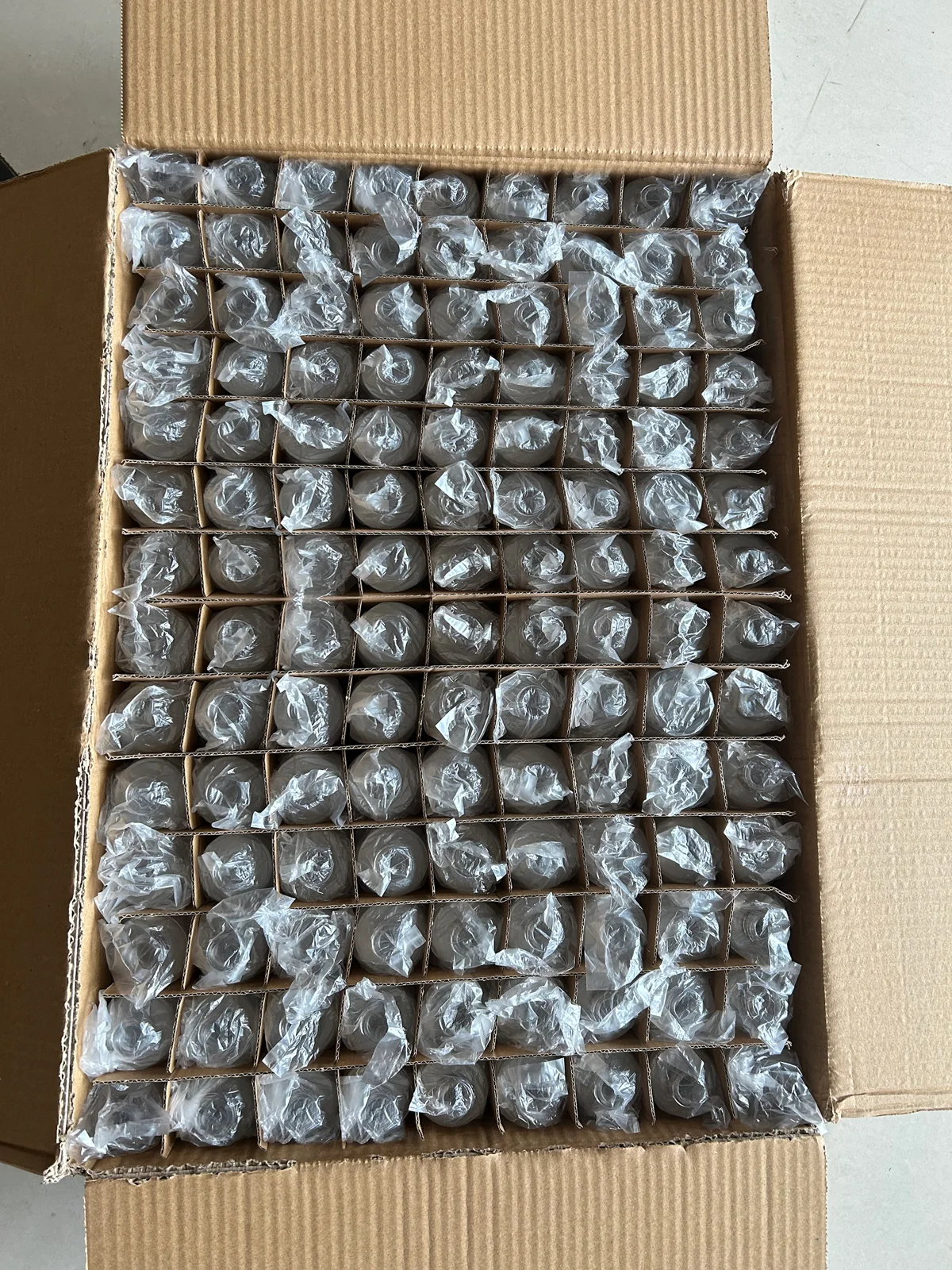
Photographed at Oulete
From the sample room to packed containers
See the facility and visible operations behind a packaging enquiry. For your selected assembly, ask which steps apply and request the corresponding sample and inspection records.