Cosmetic packaging · Made for your brand
Sourcing a Coordinated Airless Bottle Series for Brands
Build a coordinated 15, 30 and 50 ml airless range with exact model codes, component scope, artwork and separate SKU approval. Start from Oulete ZK29 options.
Containers only — no compounding or filling.
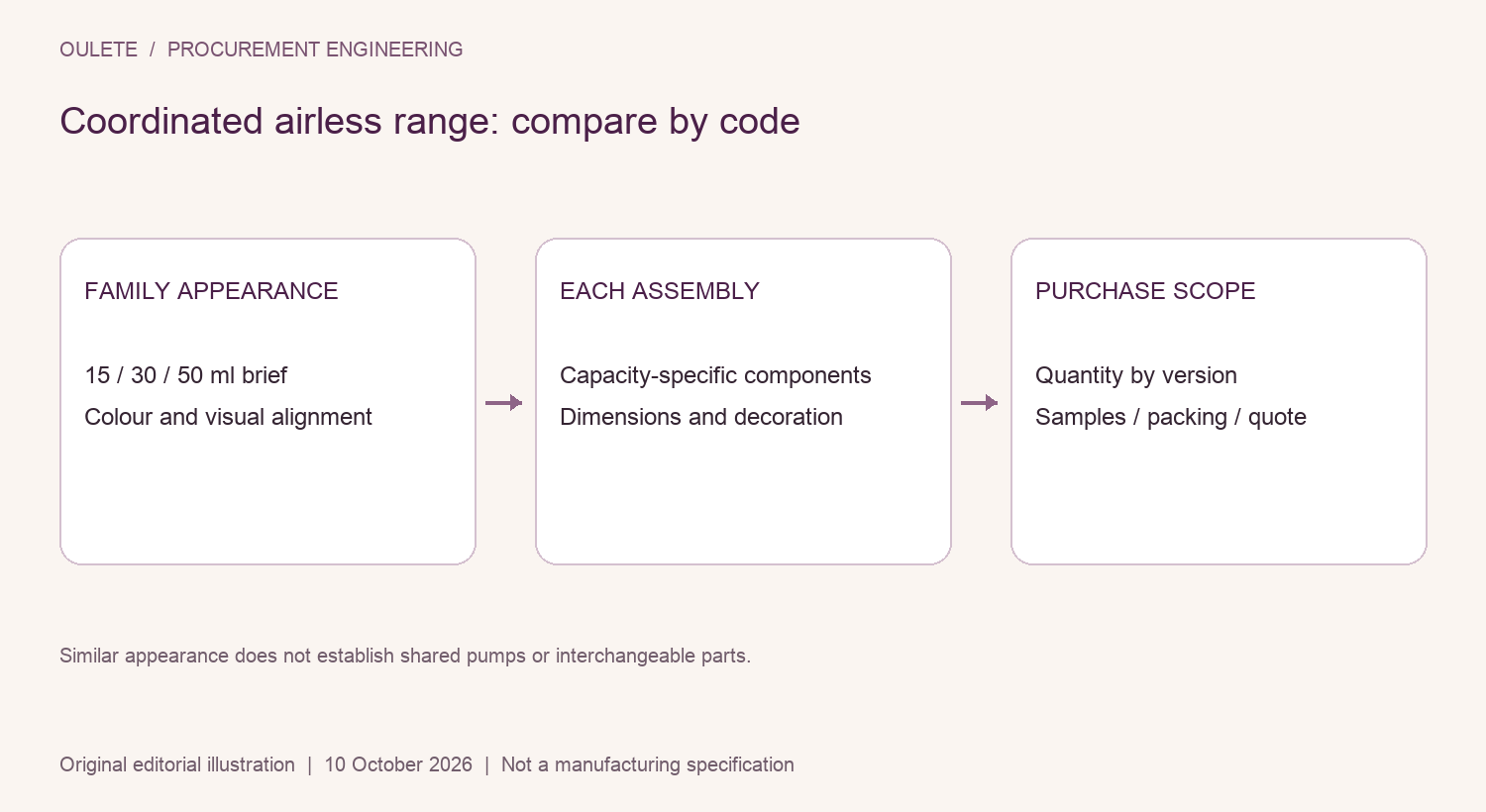
Coordinated airless range: compare by code showing family appearance, each assembly, purchase scope
On this page · 13 sections
- Define the family relationship before requesting prices
- Turn Oulete catalogue options into a SKU matrix
- Coordinated airless bottle series sourcing: catalogue and order matrix
- Separate appearance approval from component sharing
- Build the sample sequence around the range's dependencies
- Quote the series by configuration and purchase scope
- Frequently asked questions
- Can one airless family supply all three skincare products?
- Which capacities are listed for Oulete ZK29 variants?
- Are pumps and caps interchangeable within a family?
- Can we order a total of 2,000 split across several sizes?
- Can one artwork file be scaled for the entire series?
- What if only part of the range is approved?
Coordinated airless bottle series sourcing requires a configuration list for every product in the range. Matching family names and capacities can help create a visual shortlist, but they do not establish shared pumps, equivalent formula performance, identical artwork areas or a combined production MOQ.
Source a coordinated airless series by naming each code, capacity and component configuration, then approving the range's appearance and each SKU's functional requirements separately.
A brand buying a serum, eye treatment and moisturizer may want one recognizable silhouette across several sizes. Purchasing also needs to know which assemblies can be quoted together, which colours apply to which parts, and what happens if one product is delayed. A range proposal should answer those decisions rather than simply arrange three bottles in a photograph.
Define the family relationship before requesting prices
A coordinated airless series is a group of selected assemblies intended to present a related appearance across several products. Coordination is a design objective. Component interchangeability is a technical property that requires identification and confirmation. Keep those concepts separate when asking a supplier to propose the range.
Describe the relationship the brand wants: common shoulder shape, repeated cap profile, aligned decoration, deliberate height progression or a consistent finish. Avoid “make them all the same” when capacity, formula and application differ. Ask which visual features can remain common and which differences the supplier proposes to preserve the selected function.
A useful external example is Aptar's Stella leaflet. It lists a 15, 30 and 50 ml family with different diameters and total heights. Those supplier-published dimensions illustrate that a coordinated appearance does not require one physical envelope. They are not Oulete dimensions or proof of interchangeable parts across another family.
Aptar's airless portfolio page describes multiple actuator and cap designs for Mezzo. That named supplier example shows why the family-level appearance request should still identify the proposed components. It does not establish that any Aptar or Oulete part is interchangeable across capacities.
Use photographs to communicate the design direction, then request the current assembly drawing for each shortlisted size. The drawing should identify the envelope that matters to artwork, filling fixtures and external packaging. Do not reuse a body-only height as the height of a capped assembly or estimate dimensions from a perspective image.
If the brand wants one common actuator, state that as a requested design feature. Ask the supplier to identify the actual component references and compatible configurations. The commercial value of a shared part depends on whether it can be approved for the relevant assemblies and formulas, not on whether two caps look similar from the front.
Turn Oulete catalogue options into a SKU matrix
Oulete's ZK29 catalogue provides named variants and nominal capacities for building an initial series shortlist. The confirmed catalogue references are ZK29, ZK29-1, ZK29-2 and ZK29-3, each listed in 15, 30 and 50 ml. They are selection references, rather than complete approved specifications for a particular order.
The ZK29 product page connects these codes to Oulete's supplied catalogue. Select one code and capacity for each intended product, then request current dimensions, proposed materials and the complete dispensing assembly. A catalogue illustration does not declare the production resin grade or a colour that is automatically available at the quoted quantity.
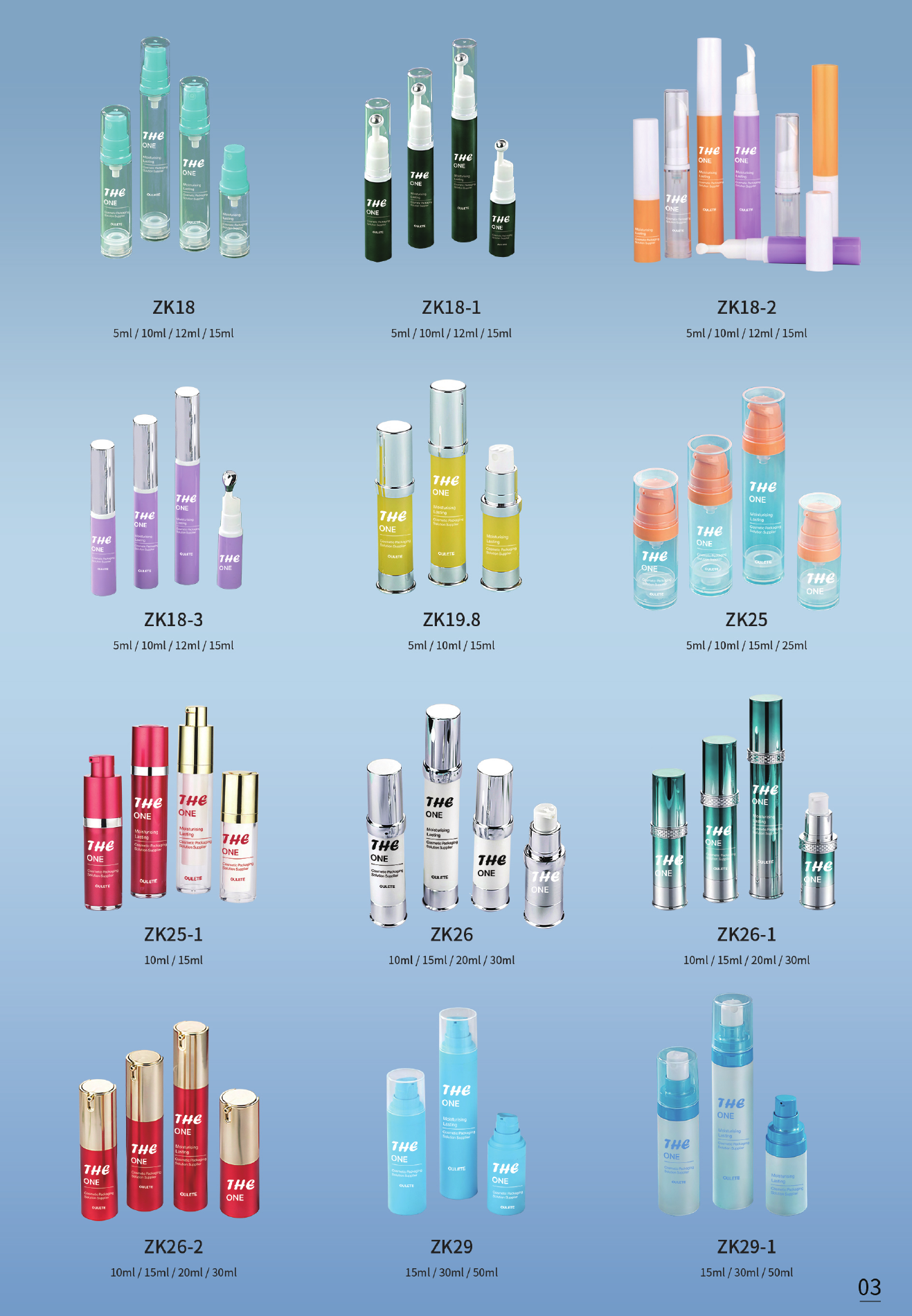
Original Oulete catalogue reference. ZK29 and ZK29-1 appear on the lower row. Use the code and capacity to request the current proposed assembly; the illustrated colours are not an order specification.
Coordinated airless bottle series sourcing: catalogue and order matrix
| Oulete catalogue code | Listed nominal capacities | Catalogue reference | Specify before quotation |
|---|---|---|---|
| ZK29 | 15 / 30 / 50 ml | Product Catalog 1, printed page 03 | Capacity, proposed complete assembly, colour and artwork |
| ZK29-1 | 15 / 30 / 50 ml | Product Catalog 1, printed page 03 | Capacity, proposed complete assembly, colour and artwork |
| ZK29-2 | 15 / 30 / 50 ml | Product Catalog 1, printed page 04 | Capacity, proposed complete assembly, colour and artwork |
| ZK29-3 | 15 / 30 / 50 ml | Product Catalog 1, printed page 04 | Capacity, proposed complete assembly, colour and artwork |
A range can use one catalogue code across several capacities or mix selected variants to create a deliberate relationship. Both approaches need a product-by-product record. Add the brand's SKU name beside the supplier code so the eye treatment's artwork does not become associated with the serum's body during sample preparation.
Keep the formula reference and dispensing requirement in the matrix. The nominal capacity indicates the selected size, not the quantity per stroke or the number of customer applications. Each product can have a different intended user action even when the containers share a family appearance. Ask the supplier to propose the relevant dispenser against that individual requirement.
The first matrix can contain unresolved fields. Label missing drawings, component references and decoration areas as requested. That is more useful than filling the cells with assumed common parts. The supplier can then return a proposal that makes the differences visible rather than embedding them in separate quotations with inconsistent descriptions.
Separate appearance approval from component sharing
Series appearance approval is a review of how the proposed assemblies relate visually when presented together. It does not replace functional approval of the individual SKU. Compare representative assembled samples with the named parts and finishes, then record which features the brand intends to share and which differences it accepts.
Lay out the samples in the intended retail or product-photography arrangement. Review cap profile, collar relationship, apparent proportions and decoration alignment. A logo that appears balanced on a tall bottle may look misplaced when copied without adjustment onto a shorter body. Ask for usable decoration areas before applying a uniform artwork position.
HCP's print-effects guidance describes orientation features for multicolour printing and tampo printing for curved surfaces. For the buyer, the useful question is which surface and locating feature belong to each ordered component. The method should be specified against the actual part rather than assumed from a shared family logo.
Choose a physical appearance reference that the parties can identify. A screenshot of a competitor range can explain a direction, but it should not become the production colour standard or a copy of its distinctive branding. State the desired relationship in the brand's own artwork, colour references and sample approvals.
Request a component commonality table, which identifies shared part references and the configurations they fit. It should distinguish a physically shared part from a different part with the same visible appearance. This matters when purchasing spare components, investigating a substitution or discussing whether a change affects the whole range.
| Range feature | Approval record | Question for the proposal |
|---|---|---|
| Common actuator appearance | Identified sample for each SKU | Is the same component reference used or only a similar profile? |
| Coordinated body colour | Physical reference and named substrate | Which parts and processes are included? |
| Aligned front artwork | Final-size layout for each body | What usable area and orientation apply to each configuration? |
| Shared cap preference | Cap reference by assembled pack | Which combinations have been confirmed? |
| Related dispensing experience | Formula and target action per SKU | Which dispenser proposal belongs to each formula? |
| Family carton arrangement | Actual capped dimensions and protection proposal | Is the external pack based on the current assembly drawings? |
Do not approve colour from loose parts alone when the assembled presentation is central to the range. The body, collar and cap can have different materials or finishes. Review their relationship together and specify which sample represents the visual decision. A supplier's “same colour code” does not describe every aspect of the resulting appearance.
A generic sustainability description should also remain outside the component commonality decision. Material content and any supporting claim must be documented for the selected configuration. A range with related styling does not establish one verified material claim across every capacity or decorated version. The component-material-list guide addresses that separate information request.
Build the sample sequence around the range's dependencies
A series sample plan should identify which decisions can be shared and which require individual SKU evidence. This keeps visual review efficient without allowing one tested bottle to stand in for unreviewed formulas or assemblies. The brand, filler and supplier should agree the purpose and scope of each sample set.
One early set can establish the intended range appearance. A later or parallel set can represent the proposed components and actual formulas for functional review. Record the purpose on each sample. If a decorated presentation sample uses a different internal part, that difference should be disclosed before anyone calls the complete assembly approved.
The filler needs information for each selected configuration. Provide the actual pack envelope, fill access, supplied assembly condition and any remaining closing or assembly task. Ask the filler to identify size-part requirements and unresolved handling questions. A coordinated appearance does not imply that the filling line can switch between capacities without a configuration review.
Coordinate artwork only after the usable areas are known. Keep front presentation, back information and any part-specific marks linked to the correct body and revision. A common master design can guide the family while each production file remains identified. Do not send a single unlabelled file and assume the supplier will scale every element proportionally.
The sample-approval guide provides the broader release framework. For a range, add a decision showing which SKU approvals are complete and which remain pending. Approval of the visual collection should not silently release a formulation that has not completed its relevant assessment.
Plan for partial readiness. If two products are ready and a third changes formula, ask how the supplier can quote and schedule the approved configurations without creating a mistaken mixed approval. Keep any changed part or artwork under its own revision. The commercial response should state what can proceed and what depends on a later decision.
Quote the series by configuration and purchase scope
A coordinated series quotation should identify quantity, supplied assembly, decoration and packing for every configuration. A family-level unit price is insufficient if the offers contain different parts or the buying plan uses several capacities. The comparison should show both common assumptions and individual SKU differences.
Oulete's confirmed plastic-packaging MOQ is 2,000 pieces. A request for a range should still state the quantity for each code, capacity, colour and artwork version. Ask whether any proposed grouping is accepted in the quotation. Do not assume that a family total can be divided freely across variants or that a common logo combines their production requirements.
Prepare the enquiry as individual lines: brand SKU, supplier code, nominal capacity, formula reference, dispenser proposal, finish, artwork revision, quantity and destination. Add whether the filler or buyer supplies any component. The MOQ and lead-time reference can support the commercial discussion, but the actual offer should specify its own scope and assumptions.
Separate the requested dates. A target for first sample review is different from decorated-sample approval, dispatch or arrival at the filler. If the launch requires all products together, state that dependency. If staggered arrival is acceptable, name the order in which the approved SKUs are needed so the supplier can frame a usable schedule.
Ask how future orders will identify the approved configurations. The record should connect the catalogue code to the actual component references, drawing revisions, finish and artwork. A shorthand such as “same ZK29 as last time” may hide a capacity or internal-part difference. The reorder change-control guide explains how to preserve those decisions.
Use Oulete's project brief to submit the matrix and appearance direction. Request a range proposal that distinguishes confirmed catalogue options, proposed components and open development questions. The result should be a set of identifiable buying decisions, rather than a collection of attractive bottles with an unspecified assembly behind each one.
Frequently asked questions
Can one airless family supply all three skincare products?
One airless family can provide a visual shortlist for several skincare products, but each selected assembly and formula needs its own relevant review. Confirm code, capacity, dispenser and components per SKU. A shared family name does not approve dispensing performance for a serum, treatment and cream together.
Which capacities are listed for Oulete ZK29 variants?
Oulete's supplied catalogue lists 15, 30 and 50 ml for ZK29, ZK29-1, ZK29-2 and ZK29-3. These nominal sizes are selection references. Request the current drawing, proposed materials and complete assembly for the exact code and capacity before setting artwork or purchasing production components.
Are pumps and caps interchangeable within a family?
Pump and cap interchangeability must be confirmed against actual component references and configurations. Similar profiles or common capacity options do not establish fit. Ask the supplier for a commonality table and retain the confirmed combinations with the quotation and sample record before ordering shared parts.
Can we order a total of 2,000 split across several sizes?
A total of 2,000 split across sizes requires confirmation in the Oulete quotation. The confirmed plastic-packaging MOQ is a starting commercial boundary, not an automatic mixed-family allocation. State quantity by code, capacity, colour and artwork and ask how the proposed order grouping would be accepted.
Can one artwork file be scaled for the entire series?
One master design can guide the series, but each production artwork file should match its identified usable area and configuration. Ask for part-specific layouts rather than assuming proportional scaling. Review the assembled family together so visual alignment does not obscure required differences between the products.
What if only part of the range is approved?
Partial range approval should identify the SKUs, components and decisions that are complete and those still pending. Ask the supplier to quote or schedule only the intended released scope. A later formula or artwork change should remain traceable to the affected configuration, rather than reopening every decision silently.
Photographed at Oulete
From the sample room to packed containers
See the facility and visible operations behind a packaging enquiry. For your selected assembly, ask which steps apply and request the corresponding sample and inspection records.