Cosmetic packaging · Made for your brand
Dropper Pipette Length and Wiper Selection for Serums
Choose dropper pipette length from fitted internal geometry, then verify the bottle, closure, wiper and actual formula together under defined draw conditions. Why can two droppers marked 20/400 behave differently on a 30 ml serum bottle?…
Containers only — no compounding or filling.
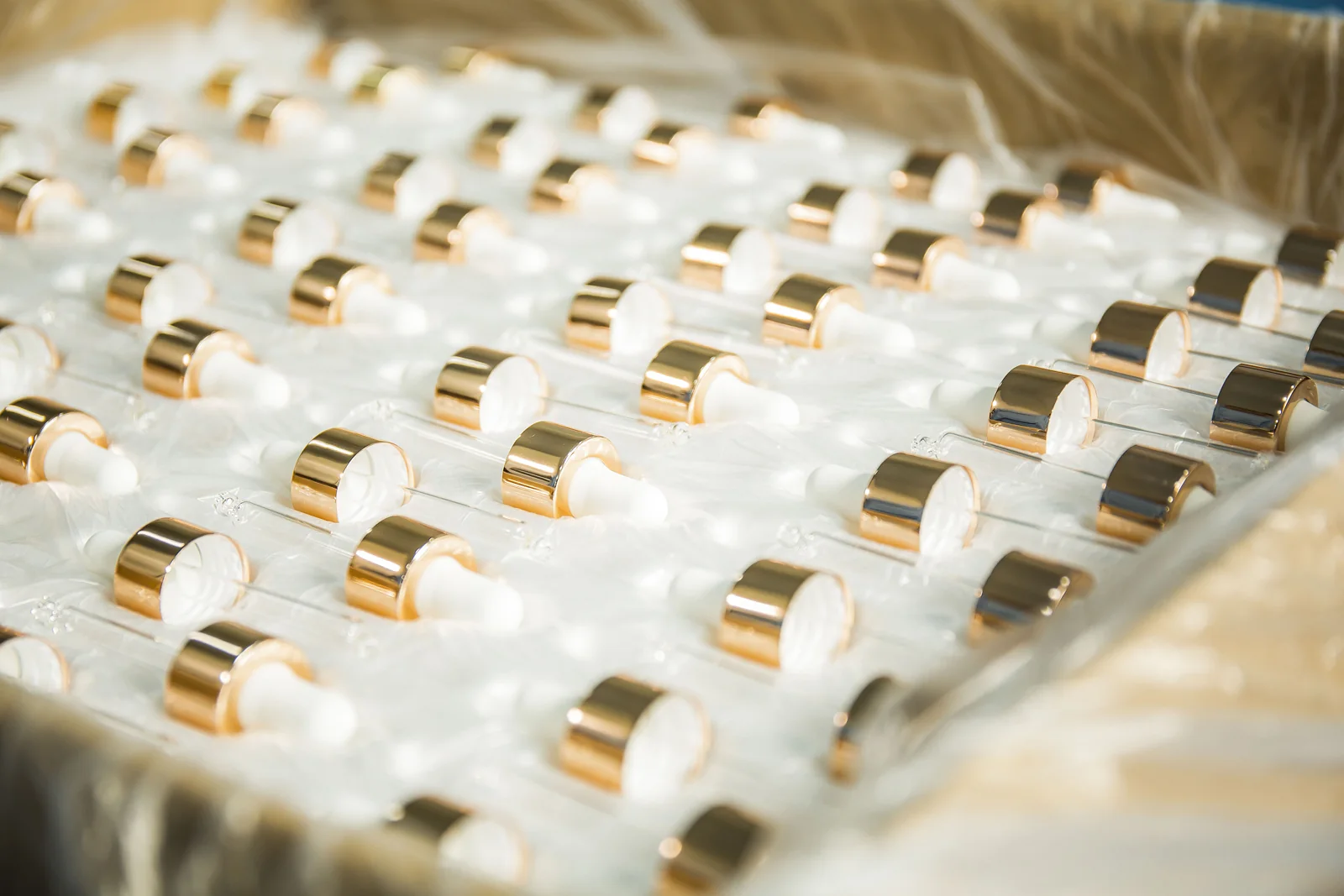
Close-up of gold-finish cosmetic packaging collars
On this page · 16 sections
- Define pipette length from the fitted assembly
- Dropper pipette length: drawing and decision table
- Check tip clearance without sacrificing liquid pickup
- Hypothetical fitted-depth calculation
- Select the wiper and contact materials together
- Wiper and dropper observations to include in a sample trial
- Evaluate draw, delivered amount and application
- Blank fitted-dropper trial worksheet
- Request a complete assembly, not an isolated tube
- FAQ
- Does a 20/400 dropper fit every 20/400 bottle?
- Can bottle height determine the pipette length?
- What gap should remain between the tip and bottle bottom?
- Does every serum dropper need a wiper?
- Can the bulb material be chosen from the formula category alone?
- Is a drop count a reliable measure of volume?
Choose dropper pipette length from fitted internal geometry, then verify the bottle, closure, wiper and actual formula together under defined draw conditions.
Why can two droppers marked 20/400 behave differently on a 30 ml serum bottle? The finish designation identifies a closure interface, but it does not describe the bottle's internal depth, the fitted pipette extension or the wiper opening. A dropper can screw onto a bottle and still bottom out, leave inconvenient residual product or carry excess formula on its exterior.
The purchasing task is to specify a complete dispensing assembly. Start with the actual bottle and closure drawings, define the installed geometry and select the contacting materials. Then test liquid pickup, withdrawal and application with the intended formula. A nominal pipette length is a component dimension; it becomes useful only when its reference points and fitted relationship are clear.
Define pipette length from the fitted assembly
Dropper pipette length is a tube dimension measured between specified reference points on its drawing. It is not automatically the distance from the bottle's sealing surface to the tube tip after assembly. Ask the supplier to distinguish total tube length, insertion into the bulb or holder, and the extension remaining inside the closed bottle.
A datum is a defined reference used to locate or measure features. For a bottle and dropper comparison, the team needs compatible reference points on both drawings. The installed seal position can differ from an external collar edge, so subtracting a catalog pipette length from overall bottle height cannot establish the internal tip clearance.
Stocksmetic's Sky dropper for the Ego 30 ml bottle is an example of a supplier-specific pairing. Its page identifies a 20/400 glass-bottle application and a corresponding scraper or wiper. The named pairing is more informative than a finish designation alone, although it still requires evaluation for the customer's formula.
The relevant bottle depth runs from the agreed installed reference to the interior region the tip is intended to approach. Internal shoulders, a raised bottom and other features may affect the usable path. An external height includes features that do not contribute to that distance. Use current drawings and fitted samples rather than reconstructing internal geometry from an image.
Dropper pipette length: drawing and decision table
| Specification item | What it controls | Required evidence |
|---|---|---|
| Complete neck and closure interface | Thread engagement and installed seal position | Bottle and closure drawings with revisions |
| Internal bottle profile | Available depth and restrictions around the tube | Internal geometry or supplier-approved fitted assessment |
| Total pipette length | Manufactured tube dimension | Defined end points and tube drawing |
| Fitted pipette extension | Distance inside the closed bottle | Assembly drawing, insertion method and datum |
| Tip geometry | Local reach and liquid delivery behaviour | Identified tip configuration and filled-pack observations |
| Wiper opening and retention | Withdrawal contact and insert location | Wiper drawing, material and bottle interface |
| Bulb or actuator configuration | Liquid draw and user operation | Selected component reference and defined trial gesture |
Nominal capacity does not determine the correct pipette. Two 30 ml bottles can have different shapes, wall distributions and internal depths. Likewise, the same advertised neck designation cannot prove an identical sealing position or shoulder clearance. Treat capacity and finish as screening information, then evaluate the complete fitted assembly.
For Oulete's 30 ml dropper bottle options, request the selected bottle drawing and proposed dropper configuration together. A catalog neck diameter is not a full thread-series designation. The neck-finish reference explains which interface information to request before a closure comparison.
Check tip clearance without sacrificing liquid pickup
Tip clearance is the space between the installed pipette tip and the bottle surface it approaches. A useful design review considers both interference and liquid pickup. A tube that reaches too far can contact the bottom or another internal feature; a shorter extension may leave liquid beyond the practical reach of the intended gesture.
The target clearance must account for the actual internal profile and assembled variation. Request the supplier's drawing limits and assessment method. A nominally positive gap in one sample does not establish the minimum gap across production, particularly when bottle geometry, tube length, seal position and insertion depth contribute to the fitted relationship.
Hypothetical fitted-depth calculation
Assume an original arithmetic exercise uses a 70 mm distance from an agreed seal datum to the internal low point, and a 68 mm fitted extension from that same datum to the tip. The nominal geometric difference is 2 mm. These invented dimensions are not an Oulete drawing, recommended clearance or approved tolerance.
| Hypothetical geometry input | Value used in the exercise |
|---|---|
| Internal depth from the agreed datum | 70 mm |
| Fitted pipette extension from the same datum | 68 mm |
| Nominal difference | 70 minus 68 equals 2 mm |
| Dimensions needed for a design decision | Bottle, tube and installed-position limits, plus actual internal profile |
The calculation would be invalid if the 68 mm were total tube length while part of the tube sat inside the holder. It would also be incomplete if the tip approached a sloped shoulder or raised feature rather than the assumed low point. Establish the measurement definitions before choosing the component.
Do not solve bottom contact by casually cutting or replacing tubes. A changed tip, tube length or insertion method creates a revised dispensing configuration. It may affect geometry, draw and application together. Have the responsible supplier define the permitted component option and repeat the relevant fitted and functional assessment on identifiable samples.
Low-fill performance should reflect the intended user action. If the product requires tilting to pick up the last usable liquid, define and evaluate that gesture. If upright use is required, assess upright draw at the agreed low-fill state. A tube that reaches a geometric low point does not establish usable evacuation with every formula.
Select the wiper and contact materials together
A wiper is an insert that interacts with the outside of the pipette during withdrawal to control carried liquid. Its performance depends on the tube diameter, insert opening, location, material and formula. Select it as part of the bottle and dropper assembly, rather than as a generic accessory added after closure approval.
Paramark's standard dropper specifications identify polypropylene closures and separate glass or LDPE plastic pipette options for named Boston Round configurations. This is useful component-level material disclosure. It does not establish a wiper option or compatibility with every serum; request the full contact-material specification for the configuration actually proposed.
The wiper's opening must be reviewed against the pipette outside geometry, including the selected tip and any variation along the tube. The bottle opening and insert retention also matter. A closure that screws down correctly can still conceal an incorrectly seated insert, interference during withdrawal or an unsupported wiper and tube combination.
Wiper and dropper observations to include in a sample trial
| Observed behaviour | Record alongside the observation | Question for the supplier |
|---|---|---|
| Formula remains on the outside of the tube | Formula, withdrawal gesture, tube and wiper references | Is the wiping combination appropriate for the intended application? |
| Tube catches during removal or insertion | Location, gesture, fitted geometry and original sample condition | Which interface requires dimensional review? |
| Insert moves or lifts with the tube | Insert position before and after operation, bottle identity | Is retention consistent with the specified assembly? |
| Leakage appears when closed | Seal, insert and closure condition, operation and storage | Is the observed path connected to the seal or another interface? |
| Draw changes after storage | Formula identity, contacting materials and elapsed conditions | Which functional and material observations should be compared? |
The bulb, liner, wiper and other contacting parts can require different material information. “Glass bottle” identifies the container, but not the elastomer, insert or closure construction. Ask the supplier to distinguish a material family from the specified grade and to identify which parts encounter the actual formula during storage or operation.
Use the actual facial-oil or serum blend in compatibility evaluation, with the relevant preparation and storage history recorded. Include fragrances, essential oils, suspended ingredients or other formula characteristics the responsible formulator considers important. A substitute test liquid may support a screening trial, but it does not establish compatibility with the intended finished formula.
Observe material and function together. Bulb changes, insert condition, sealing, pipette draw and external dripping can be connected, but a single symptom does not establish a chemical mechanism. Preserve samples for the agreed examination, retain the component lot information and keep the observation separate from a proposed explanation until the review supports it.
External reference — Virospack The Dropper Company: Assembly | Virospack
External assembly footage published by Virospack. Use it to understand the component workflow; dimensions and performance remain specific to the proposed assembly.
Evaluate draw, delivered amount and application
Dropper draw is the quantity taken into the pipette during a defined operation. Delivered amount is the quantity subsequently released to the receiving surface. The two are not automatically equal, because liquid may remain in the tube or on its exterior. A useful trial records both the gesture and the quantity being measured.
Gerresheimer's Gx Cisio product page offers flat and ball-tip tube configurations. This illustrates why the tip is part of the selected dispensing specification. A published configuration option does not establish a universal drop size, draw amount or dose accuracy for a different formula and bottle combination.
Agree the squeeze or actuator movement, immersion condition, release dwell, withdrawal angle and dispensing gesture before comparing samples. Keep the temperature and fill state recorded. A casual squeeze by one operator and a longer release by another can describe different methods, making the resulting numbers difficult to interpret as component performance.
Where the protocol measures mass, record the collected mass directly. If the brand requires volume, use density for the actual formula at the stated conditions and identify calculated volume separately. Counting drops alone does not supply a known dose unless drop mass or volume has been evaluated under the same tip and gesture conditions.
Blank fitted-dropper trial worksheet
| Record | Entry for the selected complete assembly |
|---|---|
| Configuration | Bottle, closure, bulb or actuator, pipette, liner and wiper references |
| Drawings | Current revisions, datums, fitted extension and agreed limits |
| Formula | Coded identity, batch, measured density if needed and temperature |
| Fill states | Defined initial, intermediate and low-fill conditions |
| Draw gesture | Squeeze or movement, immersion, release interval and orientation |
| Withdrawal | Angle, speed description, external liquid and any interference |
| Delivery | Gesture, collected mass or volume, dripping and retained liquid |
| Storage review | Conditions, elapsed checkpoints and component observations |
| Decision | Project criteria, raw records, reviewer and approved scope |
Separate repeatability within one sample from variation between complete packs. Repeated draw cycles can show how a single assembly behaves under the method; they do not establish that other assemblies behave the same way. The protocol should identify sample scope and sequence according to the intended decision, without borrowing an arbitrary count from another project.
Include the actual low-fill condition in the review. Record how the sample reached that state and whether the user must change the gesture to obtain product. “No draw” near empty and “less draw” describe different observations. An average taken only at initial fill cannot answer whether the selected pipette reaches usable product later.
Request a complete assembly, not an isolated tube
A complete dropper enquiry connects bottle geometry, fitted components and the required application. Give the supplier the selected bottle reference, actual formula description or controlled code, desired user action and drawing information available. Ask for the proposed closure, tube, bulb, liner and wiper as one identifiable configuration with its supplied state recorded.
Oulete's container MOQ baseline is 2,000 for plastic and 5,000 for glass. These numbers do not automatically define the minimum for every dropper, wiper, color or decoration option. Use the complete-pack quotation comparison to separate container quantities from component conditions and assembly work in the actual offer.
The reviewed Oulete TY030-30ML catalog entry identifies a PET/PETG plastic bottle with a nominal 20 mm neck diameter. That is a bottle selection reference, not proof of a 20/400 glass-bottle interface, a fitted pipette length or a complete approved dropper pack. Request the current drawings and supplier-proposed matched components for the specific project.
Approve identity and fit before treating decoration samples as functional evidence. The sample approval guide separates appearance from complete-pack function. Record which pipette and wiper were tested, and keep the configuration revision attached to the results so a reorder cannot silently substitute a visually similar component.
Send an Oulete sample brief with the bottle reference, intended formula, drawing questions and required application. Request a documented matched-assembly proposal and a trial scope covering fit, draw, external wiping and low-fill use. This gives the packaging team a concrete selection task and the buyer an approval record it can carry into production planning.
FAQ
Does a 20/400 dropper fit every 20/400 bottle?
A matching finish designation does not establish every fitted dropper requirement. Confirm seal position, bottle internal geometry, pipette extension, insert interface and actual sample performance. The closure may engage while the tube length or wiper combination remains unsuitable for the application.
Can bottle height determine the pipette length?
Overall bottle height cannot by itself determine the fitted pipette length. The review needs internal depth and the installed closure datum, together with the tube's insertion and extension dimensions. External height includes features that do not describe the available internal path.
What gap should remain between the tip and bottle bottom?
The required tip clearance must be agreed from the actual geometry, component limits and intended draw behaviour. A nominal gap from an arithmetic example is not a production specification. Evaluate interference and liquid pickup using the selected fitted assembly and defined low-fill conditions.
Does every serum dropper need a wiper?
A serum dropper needs the insert configuration specified for its matched assembly and application. Some supplier pairings require a wiper, while others offer it as an option. Evaluate exterior liquid, withdrawal, retention and sealing with the actual formula before approving the configuration.
Can the bulb material be chosen from the formula category alone?
A formula category alone does not establish bulb compatibility. Request the actual bulb and other contact-material specifications, then evaluate the intended blend under agreed storage and operating conditions. Keep material observations and dispensing results attached to the tested assembly.
Is a drop count a reliable measure of volume?
A drop count does not establish volume without a defined drop quantity for the actual formula, tip and operation. Measure delivered mass or volume under the agreed method, and use measured density when converting mass. Keep the gesture and temperature in the trial record.
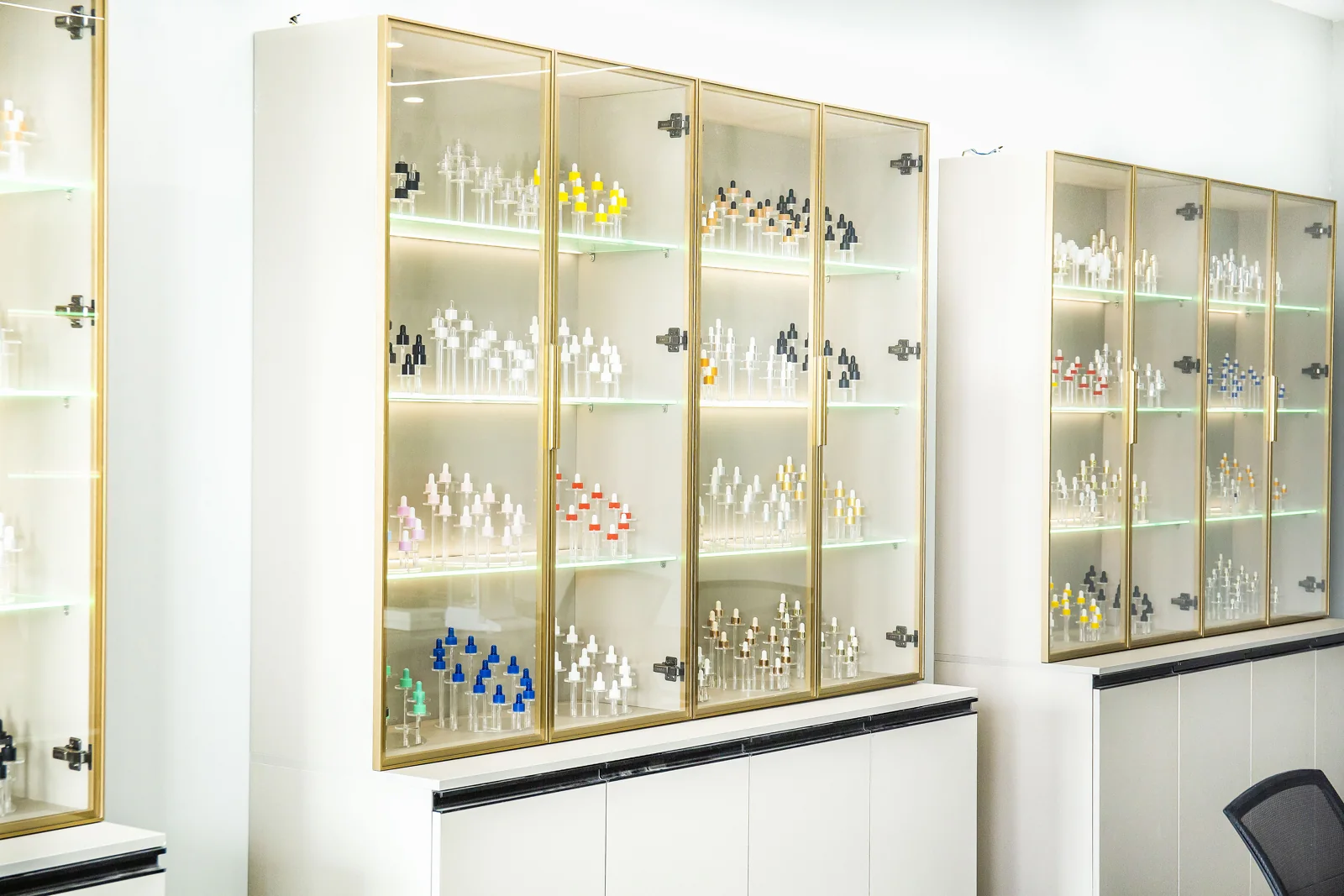
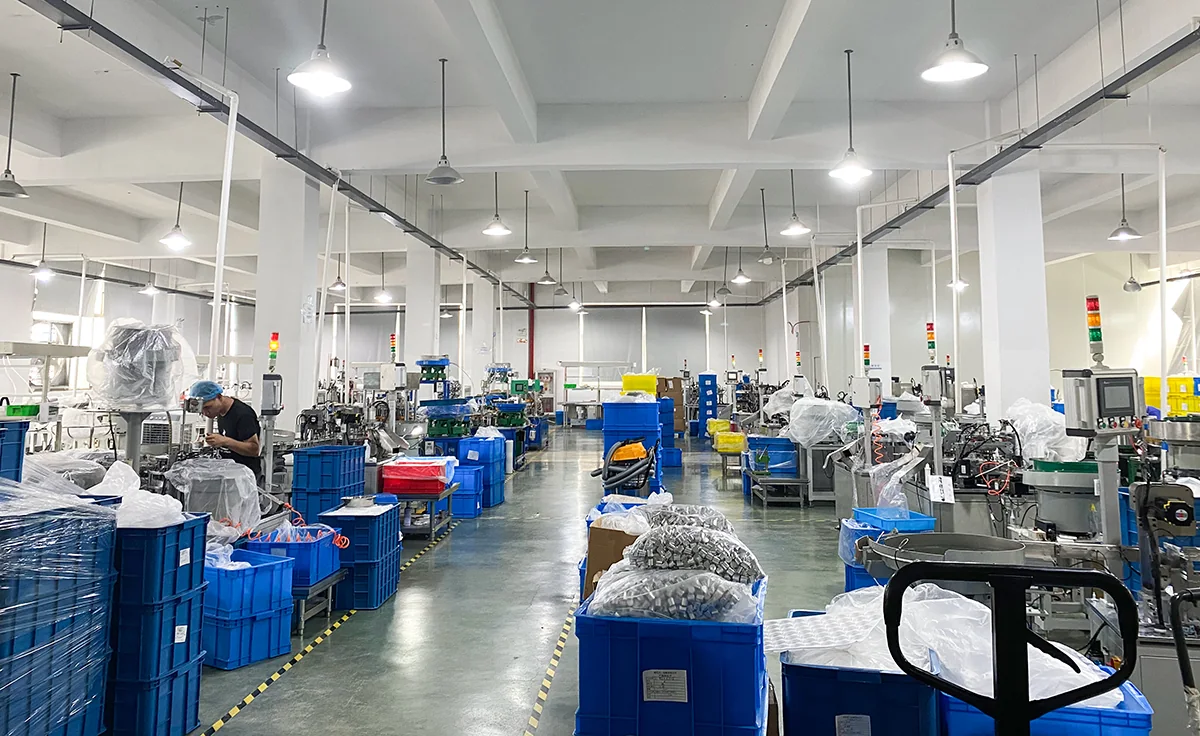
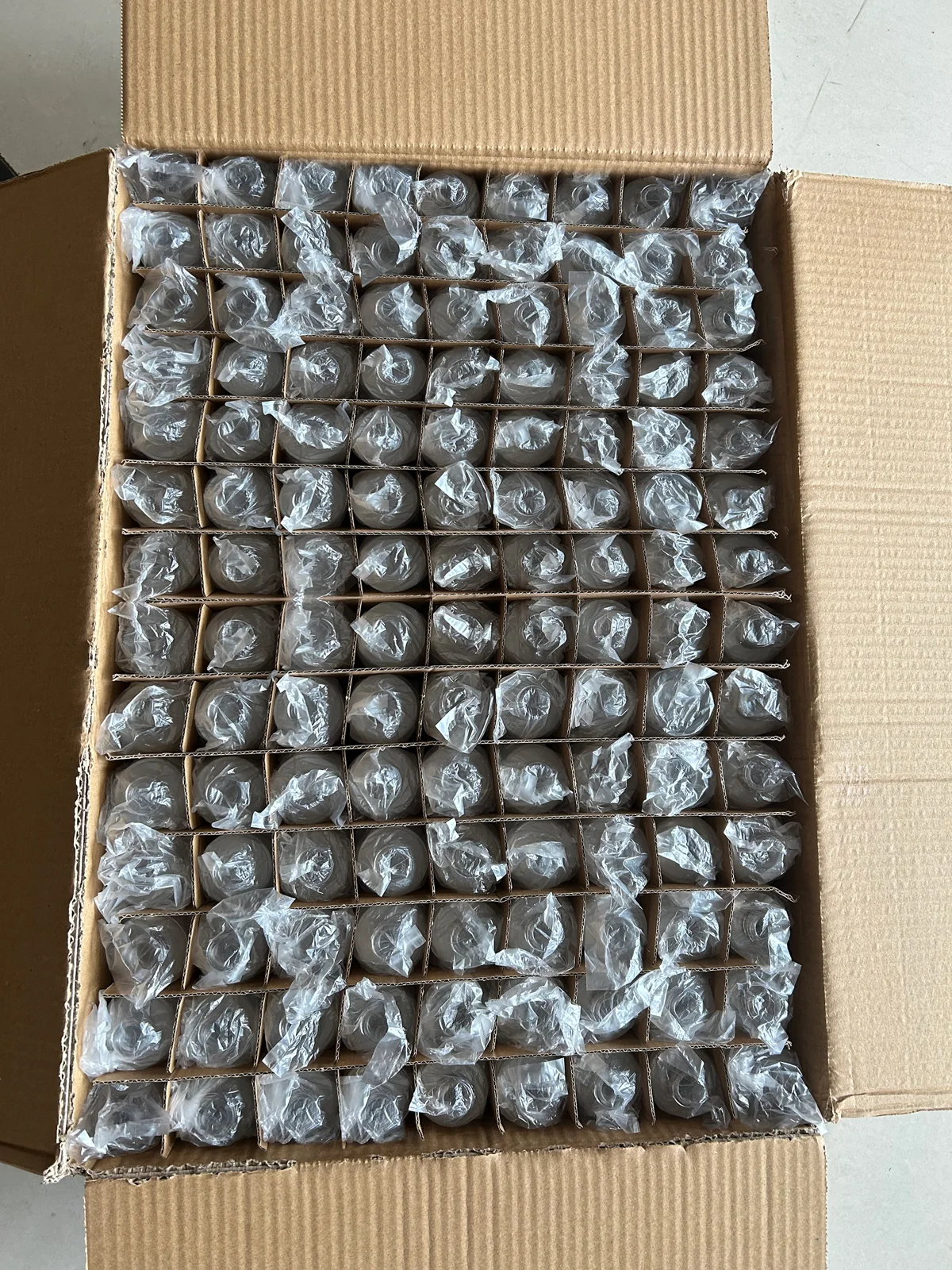
Photographed at Oulete
From the sample room to packed containers
See the facility and visible operations behind a packaging enquiry. For your selected assembly, ask which steps apply and request the corresponding sample and inspection records.