Cosmetic packaging · Made for your brand
Cosmetic Pump Travel Locks: Choosing the Closed State
Compare cosmetic pump travel locks by closing action, reopening, loose parts and fluid-sealing scope. Request an identified Oulete assembly and sample proposal.
Containers only — no compounding or filling.
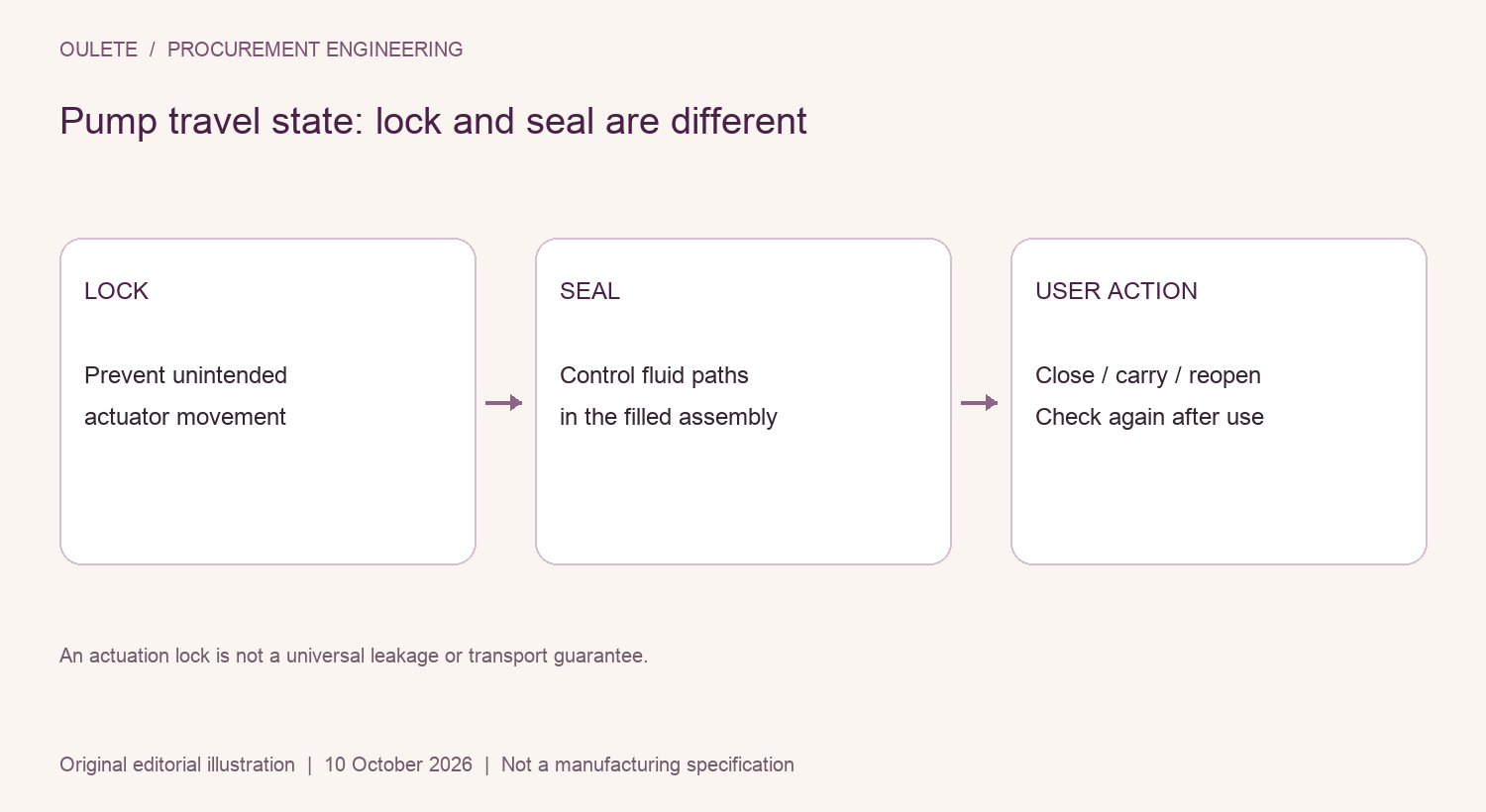
Pump travel state: lock and seal are different showing lock, seal, user action
On this page · 13 sections
- Identify what the lock actually controls
- Compare the buyer's closing and reopening tasks
- Cosmetic pump travel lock selection: mechanism comparison
- Keep actuation prevention separate from fluid sealing
- Review the lock after the pack has been used
- Request a lock proposal that can be quoted
- Frequently asked questions
- Is a locked cosmetic pump automatically leakproof?
- Which is better for travel: up-lock or down-lock?
- Can a clip replace an overcap?
- Does a twist lock provide tamper evidence?
- Should we test an unused pack or one already opened?
- What should we ask Oulete to include in a lock quotation?
Cosmetic pump travel lock selection is a choice about the complete pack's closed state, how the user recognizes it and how the user reopens it. A label saying “lockable” leaves important questions unanswered: what movement is blocked, whether product is expelled during locking, and which components provide the fluid seal.
Choose a travel lock by its closed-state mechanism, reopening action and complete-pack evaluation; preventing an actuator stroke does not establish a fluid seal.
Consider a travel lotion that is used at home, closed for a bag, reopened at the destination and closed again. The first factory-closed state represents only part of that experience. A buyer should ask for a demonstrated repeat-use sequence with the proposed bottle and formula before approving the lock as a product feature.
Identify what the lock actually controls
A pump lock is a mechanism that restricts or changes actuator movement in a defined state. The supplier should describe that state for the exact dispenser. Terms such as up-lock, down-lock and twist-lock are procurement starting points, but names alone do not establish the internal valve arrangement or the seal of the assembled container.
A published pump patent, WO2023094337A1, describes conventional up-lock and down-lock arrangements in its background discussion. A down-lock description generally indicates a depressed actuator in the locked presentation. An up-lock description generally indicates locking without retaining the actuator in that depressed presentation. Ask the supplier to demonstrate both, because the instruction sequence and any product expelled while closing are properties of the proposed mechanism, not assumptions to make from the label.
A twist-lock uses a rotational action to move between identified operating states. Confirm which part turns, whether the collar or bottle attachment can move unintentionally, and how the user recognizes the endpoint. A printed arrow can support instructions, but the direction and meaning must correspond to the actual sample.
An external clip is a separate part intended to restrict movement in its designed position. An overcap is a cover fitted over the dispensing assembly. Either may be useful in a travel presentation, but neither name proves protection from every force or leakage path. Request the fit, retention and intended function for the identified design.
A real supplier example is Aptar's PZ Twist, described with an audible opening and closing click and no required cap. This is evidence of that named spray-pump proposal. It is not evidence that all twist locks provide the same feedback or that Oulete stocks this Aptar mechanism.
Compare the buyer's closing and reopening tasks
Travel-lock selection should start from the consumer's repeated closing task, rather than only the assembly's shipping photograph. Describe whether the pack travels unopened, travels after use, sits in a retail carton or is sold without a carton. Those situations create different questions about instructions, exposed parts and the condition in which the pack is evaluated.
Cosmetic pump travel lock selection: mechanism comparison
| Mechanism description | Ask the supplier to demonstrate | Consumer detail to review | Purchase specification to retain |
|---|---|---|---|
| Up-lock | Locking from the operating position and reopening | Recognition of locked state without assuming an actuator position | Exact pump reference and locking sequence |
| Down-lock | Depressing, engaging the lock and reopening after use | Whether closing expels contents or needs a defined sequence | Closed height and instructions for the selected assembly |
| Twist-lock or locking ring | Part rotation, endpoint and behavior under ordinary handling | Visible or tactile indication and grip with product on the hands | Identified moving part and approved state markings |
| Separate clip | Fitting, removal and refitting | Storage of a loose part and recognition of correct placement | Clip reference and inclusion in supplied packs |
| Overcap | Fitting, retention, removal and refitting | Grip, outlet contact and the effect on pack height | Matched cap reference and assembled envelope |
| Combined arrangement | How each part contributes to the closed state | Whether one action is easily omitted | Full component scope and the intended user sequence |
The table compares questions, not a ranking of universal winners. A compact cap can suit one brand's presentation while a separate clip creates an unwanted loose part for another. A down-lock may produce a lower closed envelope, but the buyer needs the actual dimensions and closing demonstration before selecting cartons or advertising a compact format.
Ask a person unfamiliar with the sample to follow the proposed instruction. Record where they hesitate, which part they grip and whether they believe the pack is closed. This is an original user-review task, not a certified usability test. The responsible team should decide the review scope and what changes are required before instruction approval.
Consider the decoration state too. A polished collar, painted actuator or printed symbol can change the visible cues presented to the consumer. Review a representative decorated sample where those cues matter. A clear development sample may communicate the mechanism differently from the final opaque or reflective finish.
Keep actuation prevention separate from fluid sealing
A blocked actuator and a sealed fluid pathway are separate functions that must be identified in the complete pack. The lock may address accidental strokes while bottle attachment, seals, venting and internal dispenser parts still need review. A closed actuator photograph provides no record of how those interfaces were assembled.
Ask the supplier which components participate in the closed state and which components seal the contents. The proposal should name the dispenser, bottle interface, applicable sealing parts and external lock or cap. Where relevant, request a drawing showing the assembled condition. The neck-finish reference can support the bottle-interface discussion without implying that a matching diameter proves a seal.
Aptar's Future Airless PET page describes a locking ring paired with a free-spinning actuator. Its transport qualification statement also notes that results can vary with the container and formula. The example supports configuration-specific review; it does not transfer an Aptar test outcome to a different bottle, formula or Oulete assembly.
Distinguish a mechanism claim from a logistics claim. “Twist to lock” describes an action. “Suitable for our filled pack in the intended distribution route” requires evidence tied to that pack and the agreed evaluation. Ask for the basis of any supplier transport statement, including which container, contents and external protection it concerns.
A supplier can offer a lock demonstration while the filled-pack decision remains pending. That is a useful stage boundary. It allows the brand to select the intended consumer action without making a premature leakage or transport claim. Record what has been reviewed and what still requires representative samples, formulation input or distribution-specific assessment.
Do not infer tamper evidence from a lock. A reusable rotational lock may help travel handling without providing an irreversible first-opening indication. If first-opening evidence is a requirement, identify it separately in the brief and ask for the proposed feature. The consumer instructions should not imply a safety function the supplied mechanism does not provide.
Review the lock after the pack has been used
A repeat-use travel review concerns the pack after dispensing, rather than only an untouched factory-closed sample. The brand should identify the expected sequence and ask the supplier which samples can represent it. Formula residue, refitting behavior and the state of external parts belong in that discussion.
Observe the sequence from first opening through dispensing, reclosing and reopening. Record whether the consumer needs to hold the collar, rotate a particular part or press the actuator. If pressing is involved, describe any discharge observed while closing. The supplier should resolve unclear instructions before the brand commits to artwork saying “lock for travel”.
The outlet should be part of the review. Ask whether an overcap touches the outlet or a part exposed to the contents, and what happens when it is refitted after use. Keep the observation tied to the selected component reference. A cover that fits an empty sample can still require a different practical assessment after actual dispensing.
For a refillable presentation, distinguish reopening for dispensing from opening the pack for refill replacement. A consumer should not need to guess whether a twist movement unlocks the actuator or releases a refill interface. If the brand requires both operations, request a demonstration and written sequence for each, with the parts clearly identified.
Oulete's refillable-packaging route is a place to discuss refill requirements. Its confirmed glass outer jar, removable refill and magnetic lid do not establish a pump travel lock. A new combination should remain a development request until the proposed assembly and operation are identified.
Retain the selected instructions with the sample approval. If the cap, clip, actuator or finish changes, determine whether the change affects the closing sequence or state recognition. The packaging reorder change-control guide helps carry that approved configuration into subsequent orders.
Request a lock proposal that can be quoted
A quotable travel-lock brief names the pack, the intended user sequence and the supplied components. A request for “travel-proof packaging” is too broad to identify the design or evidence needed. Describe the application and ask for a configuration-specific proposal, with open questions retained in the quotation.
The enquiry should identify nominal capacity, formula category, bottle selection and required dispensing experience. State whether travel begins before or after first use. Explain the closure preference and whether a loose clip or overcap is acceptable. Send the intended market and external pack format so the project team understands the use and distribution context.
For an airless starting point, Oulete's ZK29 family provides catalogue codes for requesting the complete assembly. Do not assume that every family variant shares the same actuator or travel feature. Ask which lock option is actually proposed for each selected code and capacity and whether its state changes the assembled dimensions.
Oulete's confirmed MOQ starts at 2,000 pieces for plastic packaging and 5,000 for glass packaging. The offer should distinguish the bottle from the complete supplied assembly and identify separate lock, clip or cap items. The general MOQ does not settle the conditions for a newly developed mechanism, special colour or multiple artwork versions.
Use the custom project brief to request samples showing the proposed open and closed states. Ask for the component references, available drawing information and instruction sequence. Agree whether the samples are for mechanism review, decorated presentation, filled-pack assessment or a combination of named tasks.
The commercial comparison should use the same inclusion basis. One offer may include an overcap and another may exclude it. Another may quote loose parts while a competing offer includes assembly. Resolve those differences before comparing unit prices. Keep the closure state and consumer instructions as controlled parts of the selected proposal.
A useful approval record states which action the brand accepted, which sample configuration represented it and which filled-pack or transport questions remain open. That record is more valuable than a generic “travel lock approved” line, because it tells purchasing and the filler what the decision actually covered.
Frequently asked questions
Is a locked cosmetic pump automatically leakproof?
A locked cosmetic pump is not automatically evidence of a leakproof complete pack. The actuator lock and the fluid-sealing interfaces must be identified separately. Request the proposed assembly and evidence for the intended contents and use conditions before approving a sealing or transport statement.
Which is better for travel: up-lock or down-lock?
Up-lock and down-lock suitability depends on the proposed mechanism and consumer sequence. Ask for demonstrations of closing and reopening after use, along with the closed dimensions. Compare handling and possible discharge during closing rather than selecting a universal winner from the mechanism names.
Can a clip replace an overcap?
A clip can replace an overcap only where the proposed pack's intended functions and requirements support that choice. Ask which function each part provides, how it fits and whether it is included in the quoted assembly. A clip reference alone does not establish outlet protection or fluid sealing.
Does a twist lock provide tamper evidence?
A twist lock does not by itself establish tamper evidence. Reusable locking and irreversible first-opening indication are different requirements. If the brand needs both, request the identified feature for each and review the instructions against the proposed samples before approving claims or artwork.
Should we test an unused pack or one already opened?
The sample-review scope should reflect whether the pack travels before or after use. An untouched closed sample does not represent every repeat-use sequence. Define the intended opening, dispensing, reclosing and reopening actions and retain the sample configuration with the resulting observations.
What should we ask Oulete to include in a lock quotation?
An Oulete lock quotation should identify the complete bottle, dispenser, applicable seals and external lock or cover components. Request the proposed open and closed states, sample purpose, supplied assembly condition and consumer sequence. List quantities by configuration and confirm any development work separately from the material MOQ.
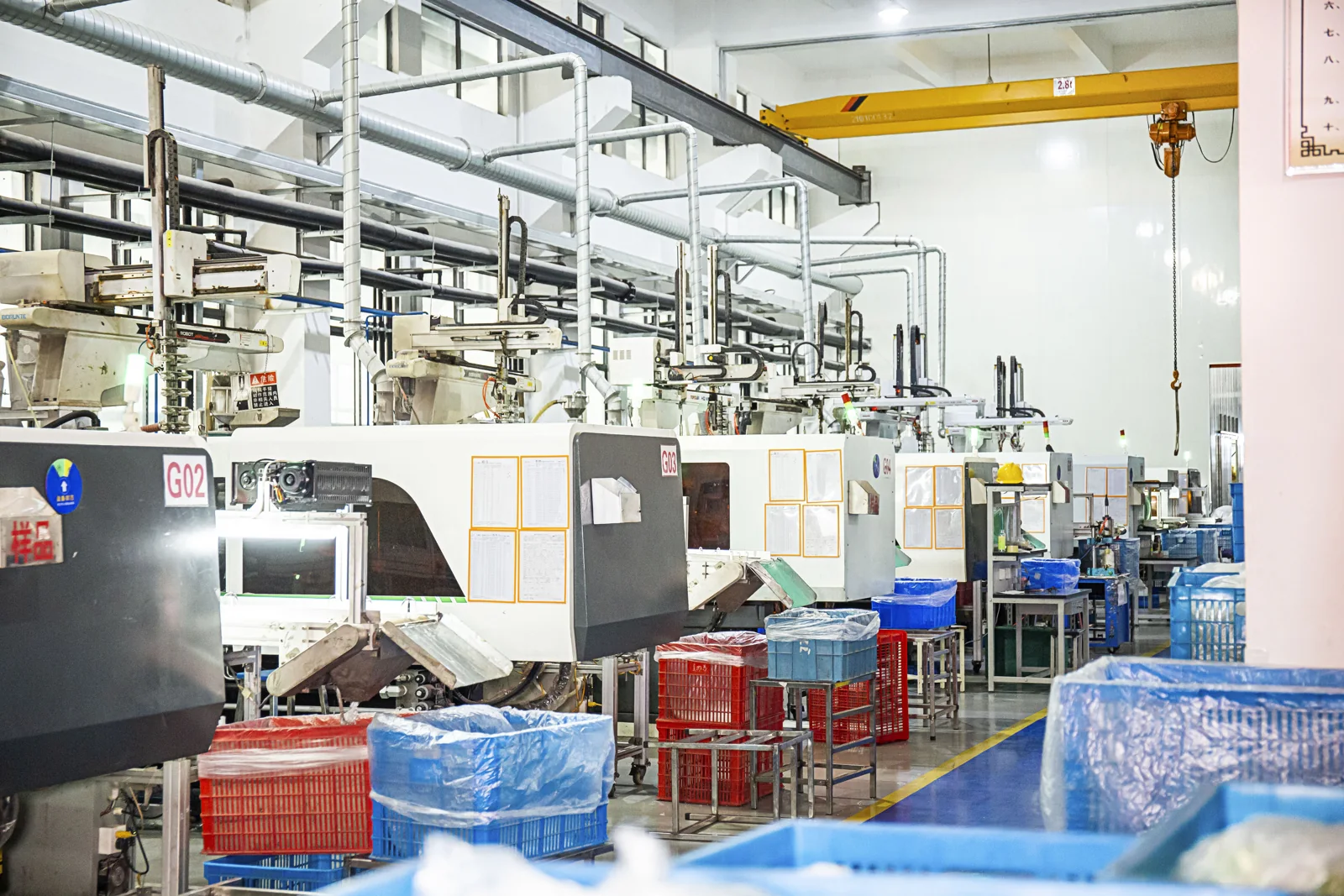
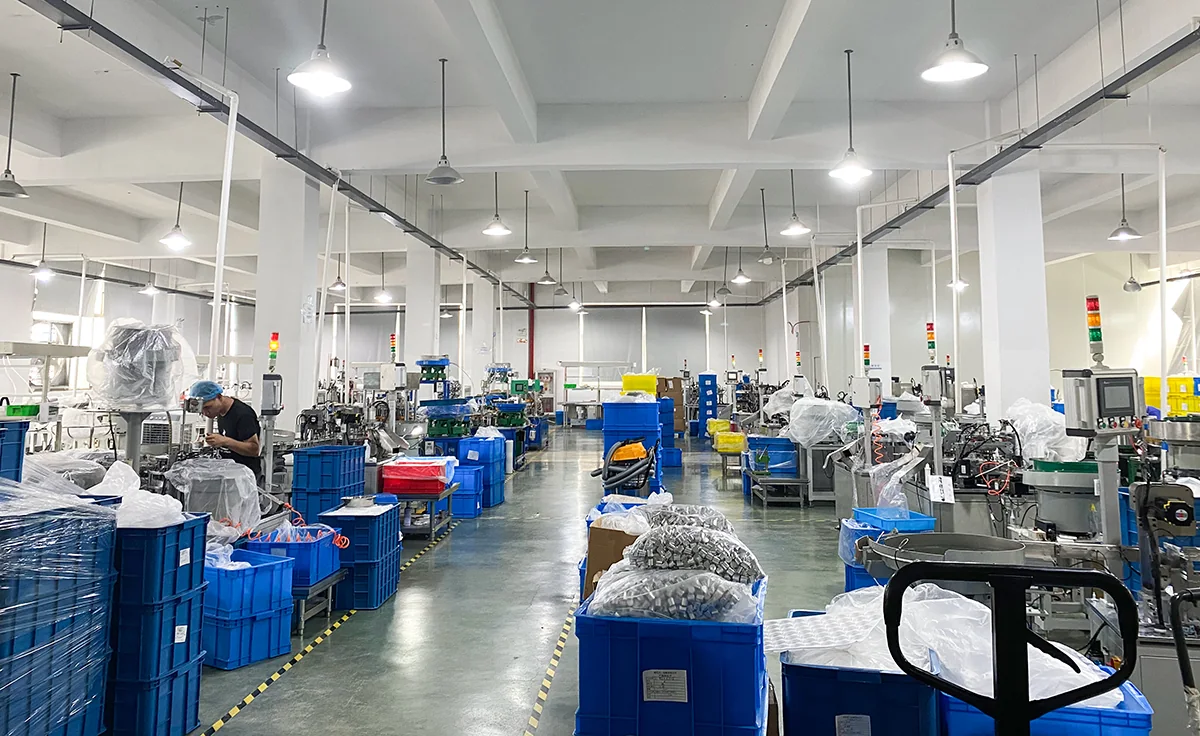
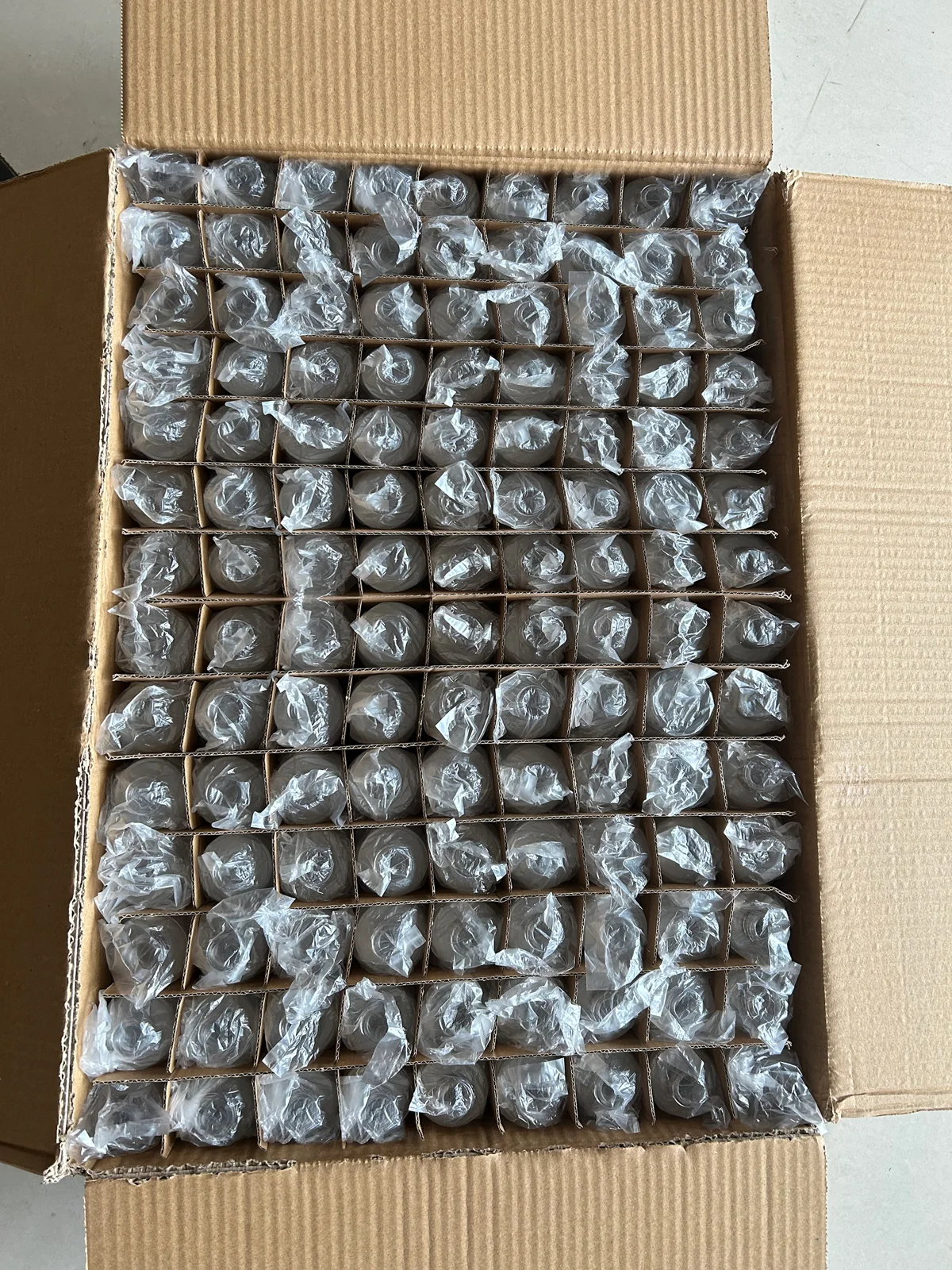
Photographed at Oulete
From the sample room to packed containers
See the facility and visible operations behind a packaging enquiry. For your selected assembly, ask which steps apply and request the corresponding sample and inspection records.