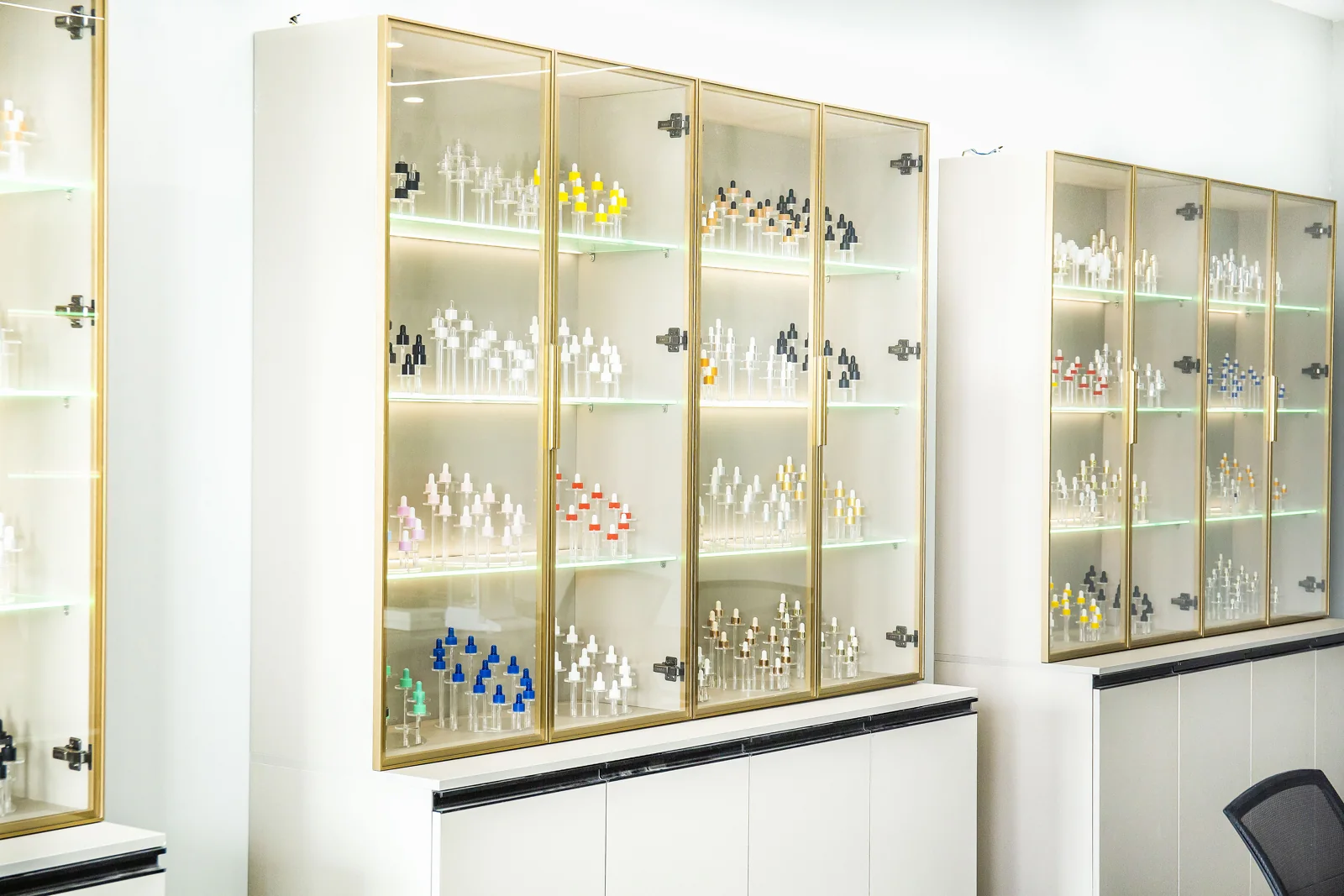
Cosmetic packaging · Made for your brand
Cosmetic Packaging Technical Drawings: Buyer Checklist
A cosmetic packaging technical drawing should identify the body, closure, dispensing parts and assembled envelope, then connect each interface to a controlled revision. A bottle drawing arrives with an outside diameter and overall height…
Containers only — no compounding or filling.

Operator's hands positioning a packaging component at an assembly fixture
On this page · 12 sections
- What belongs in a cosmetic packaging drawing pack?
- Read the body drawing without inventing the missing interface
- Give the filler and carton supplier the assembled envelope
- Keep the decoration layout attached to the selected part
- Close drawing review with a decision sheet
- FAQ
- Is a bottle catalogue drawing enough to place an order?
- Does a listed neck diameter establish a thread finish?
- Should purchasing add tolerances to an incomplete drawing?
- Can outside bottle height determine carton height?
- Can drawing approval replace a filled-pack trial?
- What should happen when a component drawing changes?
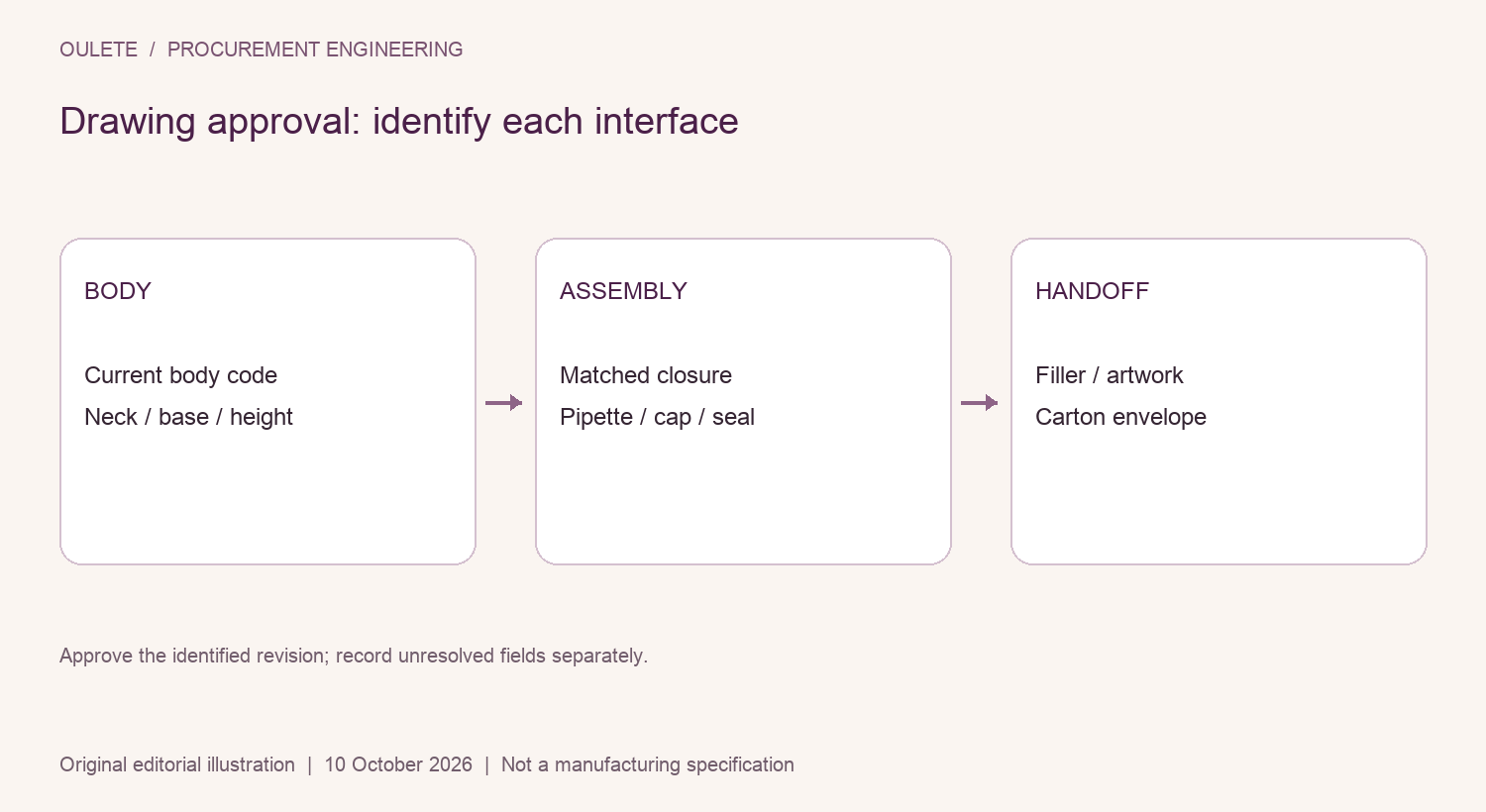
A cosmetic packaging technical drawing should identify the body, closure, dispensing parts and assembled envelope, then connect each interface to a controlled revision.
A bottle drawing arrives with an outside diameter and overall height. Purchasing forwards it to the carton supplier; the filler requests a different view; the pump supplier asks where the seal sits. The drawing may be perfectly readable, yet the project still has no agreed description of the complete pack. These teams are approving different interfaces.
Treat drawing approval as a handoff between the people who select, supply, decorate, fill and ship the packaging. The useful question is whether each team can identify the same configuration and check the surfaces it actually touches. A larger drawing file does not resolve a missing component reference or an undefined measurement datum.
What belongs in a cosmetic packaging drawing pack?
A drawing pack is a coordinated set of component and assembly documents for the configuration being considered. It can include the container drawing, closure or dispenser drawing, assembled views, decoration layout and relevant packing information. Give the documents a common assembly reference so a revised cap cannot quietly remain attached to an obsolete bottle proposal.
Ask the supplier which drawing represents the proposed order, rather than accepting an unlabelled image from a catalogue. The title block should identify the part, revision, date, units and status. A dimension is useful only when the reader can tell where it starts, where it ends and what variation is allowed for that application.
An assembly reference identifies the combination being ordered, including parts delivered loose and parts already fitted. Put the body code, closure code, dispenser code and applicable insert on that record. A catalogue code can identify the body while leaving the assembly undecided. The quotation should state who fits each loose component after filling.
| Cosmetic packaging technical drawing document | Decision it supports | Information to check before sign-off |
|---|---|---|
| Container body | Select the correct body and volume reference | Exact code, capacity designation, material proposal, body dimensions and revision |
| Neck or attachment interface | Match the proposed closure and seals | Interface geometry, sealing surfaces, fitments and agreed limits |
| Pump or dropper assembly | Identify the dispenser being purchased | Component references, installed position, applicable contact parts and supplied state |
| Complete assembled pack | Check the consumer pack and surrounding clearance | Closed configuration, assembled envelope and any relevant operating positions |
| Decoration layout | Place the final artwork on the selected part | Orientation reference, usable print area, artwork revision and excluded areas |
| Filling interface information | Prepare the actual line trial | The surfaces and dimensions the filler needs for its equipment |
| Packing proposal | Prepare protection and carton selection | Proposed configuration, orientation, protection and carton information |
Keep the commercial scope beside these documents. If the buyer supplies the closure, that needs to appear in the quotation and the assembly record. If a component is proposed by a partner supplier, identify that reference rather than describing the complete pack as one unspecified factory item. This is also the basis of a useful complete-pack quotation comparison.
Oulete-supplied assembly photograph. The image illustrates an operation; the selected sample configuration and trial results belong in the project record.
Read the body drawing without inventing the missing interface
External bottle dimensions do not describe every feature needed to approve a closure, applicator or filling interface. The outside diameter helps assess the pack envelope. Internal depth, neck geometry and sealing surfaces answer other questions. Ask for the views or sections needed by the component supplier and filler instead of deriving those features from a product photograph.
Oulete's 30 ml dropper bottle selection page presents the supplied catalogue references. TY030-30ML lists a body height of 55.9 mm, diameter of 35 mm and brim-full capacity of 33 ml. These are body-selection facts. An independently proposed dropper still needs its component identity, fitted position and actual filled-pack approval.
The same catalogue calls the TY030 neck diameter 20 mm. A diameter figure is not a complete thread-finish designation. Adding a familiar suffix to make it look like a closure standard would introduce information that the catalogue does not provide. The buyer should request the actual body interface and the proposed closure drawing as a pair.
Berlin Packaging's neck-finish guide explains the customary dimensional symbols used in its guide. They describe separate features of the finish, rather than different names for one bottle diameter. Use the symbols as reading aids where they appear on a drawing; the selected supplier's document still controls its datums and tolerances.
| Symbol in the Berlin guide | Feature described | Buyer review question |
|---|---|---|
| T | Diameter over the external threads | Which closure geometry is being matched? |
| E | Outer neck diameter below the thread peaks | Is the proposed interface fully described? |
| I | Internal opening diameter | What insert or filling access needs review? |
| H | Finish height measured using the guide's datum | Which drawing datum applies to this part? |
| S | Position of the first thread relative to the top | How is engagement defined for this interface? |
Do not turn these symbols into a universal inspection plan. The engineering parties need to specify which features are critical, how they are measured and which limits apply. For each critical feature, request a drawing callout, measurement datum, acceptance limit and decision owner. A catalogue sketch without tolerances can remain a selection reference, but it should not be promoted into a production acceptance document by adding the buyer's own guessed values.
A closure review also extends beyond thread engagement. APC Packaging's closure guidance connects threaded-closure sealing with the finish, application torque and liner selection. That is a reason to request the complete proposed sealing arrangement. It does not supply an application torque or liner specification for an Oulete model.
For bottle-cap sourcing, use the neck-finish selection guide to frame the interface questions. Keep the technical drawing and tested assembly identified in the same project record. If a reviewer cannot identify the seal or the installed component from the supplied documents, leave that decision open and name the document needed to close it.
Give the filler and carton supplier the assembled envelope
An assembled-pack drawing describes the proposed components in their installed positions. It should distinguish the bottle body from the complete closed pack and show any operating positions relevant to the brief. Otherwise, a carton can be selected for a bare bottle while the cap or actuator creates the actual height the finished pack must accommodate.
Consider a hypothetical project using the TY030-30ML body. The brand likes the shorter body proportion and asks for a dropper. The carton supplier receives the catalogue body height, while the dispenser supplier proposes a closure and bulb. The correct next document is the assembled proposal for those named parts. Adding a generic bulb height would not establish the real envelope.
For a dropper, request the pipette reference and installed extension from the identified closure datum. Total glass length and the length below the fitted closure are different measurements. Show the proposed wiper or insert, seal location and relevant internal body section. The responsible supplier must confirm the clearance; external bottle height does not provide the internal base position.
For a pump, identify the actuator, collar, cap and attachment method in the same way. A closed transport position and an operating position may create different clearance questions. Request the positions relevant to the product and packing brief. Do not assume that a dispenser from another capacity or visually similar family is an interchangeable alternative.
The filler needs the interfaces its equipment uses; the contract-manufacturer handoff identifies the teams that must resolve them. Ask the filler to mark the required features on the drawing request: handling points, support surfaces, container presentation, nozzle access, closure application and any fixture-specific clearance. These are project inputs from the actual line. The packaging supplier cannot infer the filler’s equipment requirements from the product category alone.
Keep the proposed line configuration with the sample identity. The carton supplier needs the proposed finished pack and its protection. Confirm the configuration to be packed, orientation and separation between decorated surfaces before treating a carton layout as final. Carton dimensions, packing counts and gross weight should come from the proposed packing arrangement; they are not established by the bottle drawing alone.
Keep the decoration layout attached to the selected part
A decoration layout defines how artwork is positioned on a specified packaging component. It should identify the usable area, orientation reference and artwork revision, alongside any surfaces excluded from the proposed process. Artwork approval on a flat PDF cannot by itself show how small text, seams or wraparound graphics appear on the finished component.
Use a physical orientation reference that the supplier can repeat. On a pump pack, that might be a feature defined in the proposed assembly. On a shaped bottle, it may be a named face or datum. Ask the supplier how the process locates the part. “Centre the logo” is ambiguous if each reviewer imagines a different front view.
The body, collar, actuator and cap can need separate layouts. A metallic-looking catalogue image does not establish whether a surface is coated, plated or produced by another process. Identify the process proposal for each decorated part and then review its effect on the appearance of the complete pack. The order should not depend on an image caption alone.
Give the supplier final-size artwork, including the text and graphic details the project actually needs. Ask it to identify process limits on the proposed substrate and geometry, rather than borrowing a minimum text size from another product. The screen-printing and hot-stamping comparison explains the questions to resolve through a representative decorated sample.
Drawings and decorated samples answer different questions. The layout documents intended position and area; the physical sample lets the brand evaluate the realised appearance. Keep both references together. Approval of the layout alone should not become an unsupported promise about print durability, formula resistance or the final colour under every viewing condition.
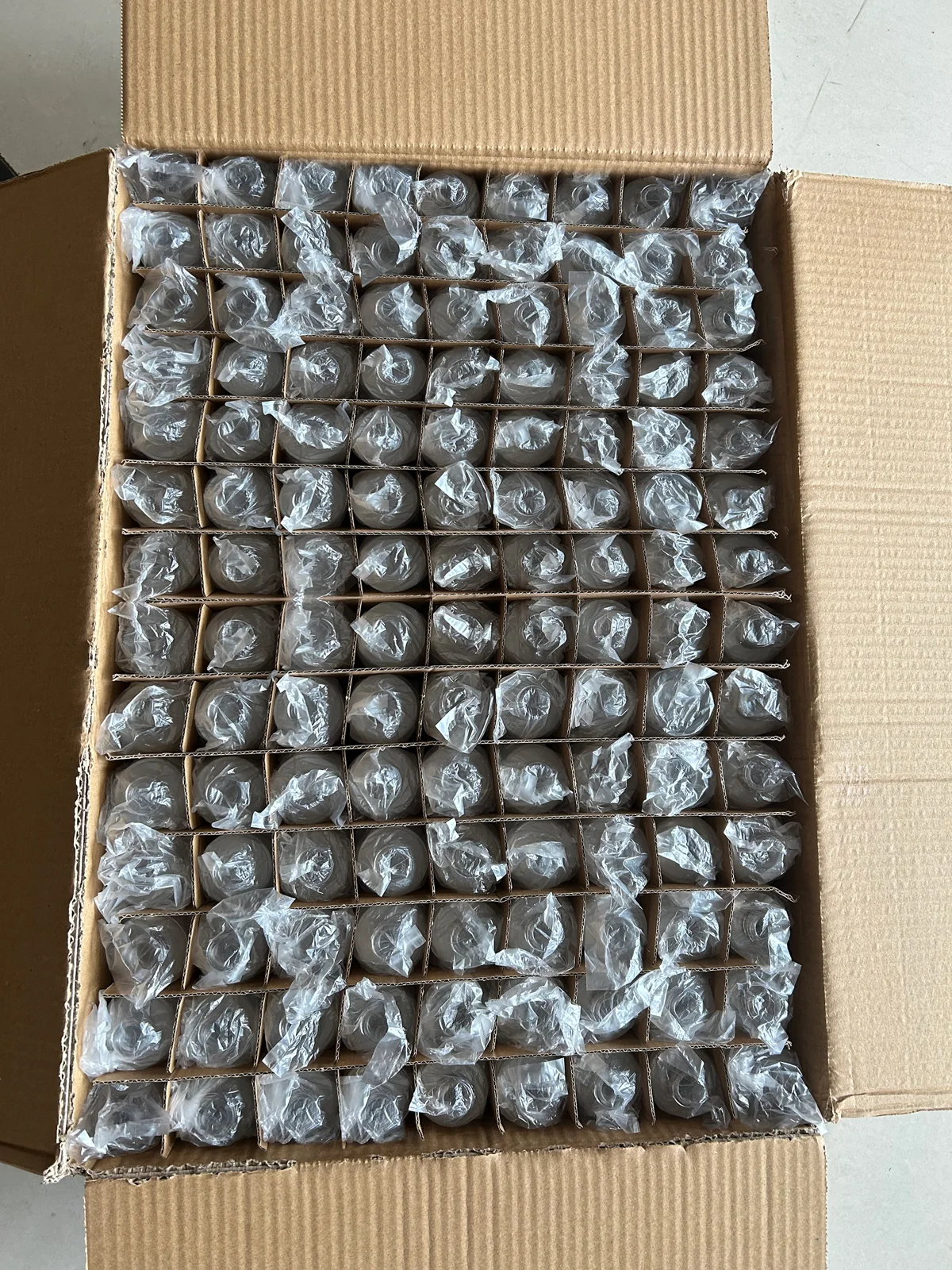
Oulete-supplied packing photograph. Agree the protection and packing arrangement for the actual finished configuration.
Close drawing review with a decision sheet
Copy the review fields below into the project record and complete them against the actual proposal. Each decision needs the assembly reference, document revision, reviewed sample identity, reviewer and date. Use a named status such as selection-only, approval-with-open-items or released-for-the-defined-scope. An unsigned PDF attachment should not quietly become a production instruction.
| Review area | Reference to enter | Decision to record |
|---|---|---|
| Body and capacity | Code, body drawing revision, nominal and brim references | Selection approved or specific dimension unresolved |
| Closure and dispenser | Component codes, fitted datum, seal and insert references | Matched proposal accepted, or supplier clarification required |
| Filler interface | Nozzle/holder/capping requirement and reviewed sample | Line review scope accepted, or trial still required |
| Decoration | Component, print-area drawing and artwork version | Layout approved or final-size sample required |
| Finished envelope | Closed/operating position and packing configuration | Carton proposal reviewed for this assembly |
| Order release | Itemised offer, drawing status and open-items owner | Released scope, exclusions and remaining actions |
A replacement component needs an impact review even when the assembly name remains unchanged. A taller closure can affect carton clearance; a new collar can affect cap application; a shifted artwork datum can affect label orientation. Name the affected documents and samples before replacing the order revision. These are review triggers, not assertions that every change causes failure.
A drawing approval is not a formula-compatibility result. Aptar's laboratory-testing page distinguishes dimensional analysis, functionality and compatibility work. Its service description belongs to Aptar. Agree the separate evaluation scope for the actual Oulete proposal with the responsible parties.
Before requesting an Oulete quotation, select the body code and capacity, describe the intended contents and application, and state which components the supplier must propose. Add quantities by configuration, decoration and destination. Oulete’s confirmed container baseline is 2,000 pieces for plastic and 5,000 for glass; individual component and decoration conditions belong in the project offer.
Submit the chosen configuration through the custom project brief. Attach the current documents and drawing-review sheet, with unresolved rows clearly identified. The request then has a concrete engineering purpose: obtain the missing interface information and a matched sample proposal that purchasing, the product team and the filler can review together.
FAQ
Is a bottle catalogue drawing enough to place an order?
A catalogue drawing can support model selection, but an order needs the applicable configuration and agreed production documents. Ask the supplier whether the drawing is current, which part and capacity it covers, and where the proposed closure or dispenser is documented. Keep the quotation, drawing references and sample identity aligned before treating the configuration as ready for production.
Does a listed neck diameter establish a thread finish?
A listed neck diameter does not establish the full thread finish or sealing arrangement. The supplier needs to identify the actual interface and matched closure documents. Oulete’s TY030-30ML catalogue lists a 20 mm diameter; it does not justify adding an unlisted finish suffix. Ask for the body and closure proposal together before approving the pair.
Should purchasing add tolerances to an incomplete drawing?
Purchasing should request agreed tolerances and measurement definitions from the responsible engineering parties rather than inventing them. Identify the functional question the missing feature affects, such as sealing, insert fit or line handling. The supplier and relevant reviewer can then define the applicable limits and method. A guessed value may make the sheet look complete without resolving the actual interface.
Can outside bottle height determine carton height?
Outside body height alone does not establish the carton requirement for a finished pack. Use the selected assembled envelope, including the proposed closure or dispenser, and the packing arrangement. Ask the carton supplier to review the actual finished configuration and protection. A catalogue body dimension should not be silently relabelled as the height of an independently proposed complete pack.
Can drawing approval replace a filled-pack trial?
Drawing approval cannot replace a filled-pack trial for formula compatibility or dispensing behaviour. It identifies the configuration and geometry to evaluate. The responsible product team and filler still need to agree the test scope, conditions and acceptance criteria for the actual contents and assembly. Attach the resulting observations to the same component and drawing references.
What should happen when a component drawing changes?
A component drawing change should trigger a recorded review of the affected interfaces and approval scope. Identify the replaced revision, proposed part and reason for the change. The brand, supplier and filler can then decide which checks remain applicable and which need repeating. Update the order references after the decision so an obsolete document does not remain attached to the quotation.
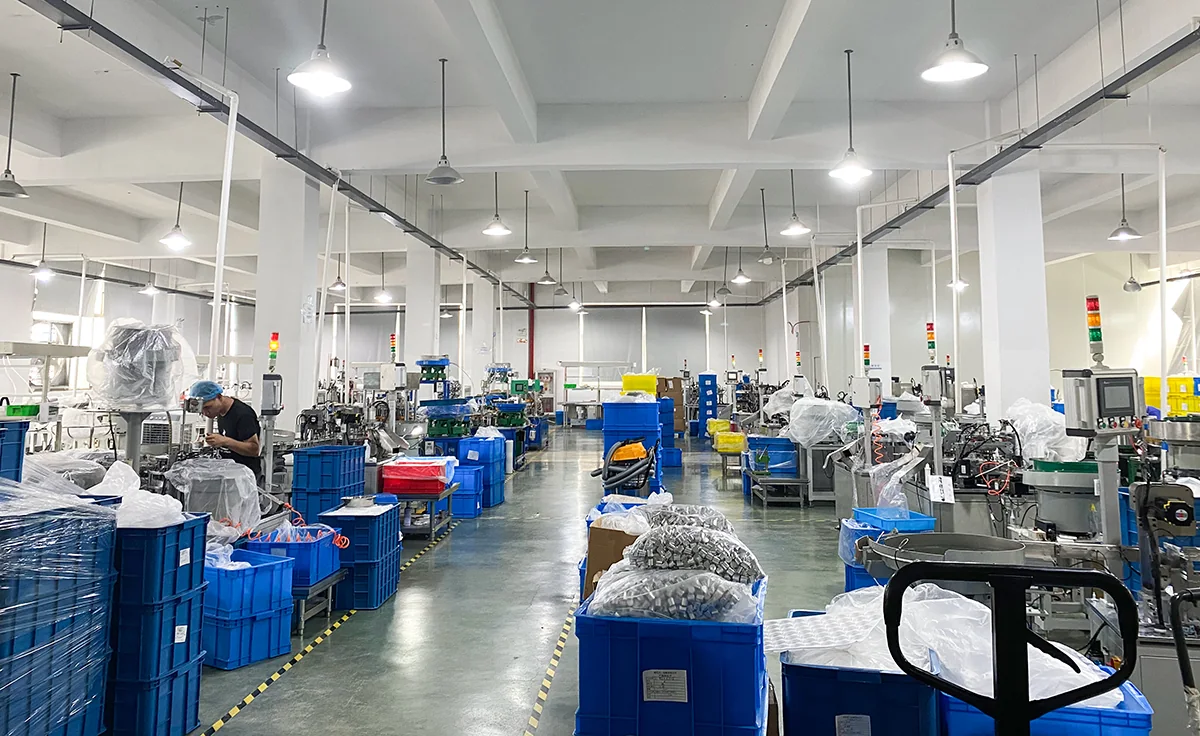
Photographed at Oulete
From the sample room to packed containers
See the facility and visible operations behind a packaging enquiry. For your selected assembly, ask which steps apply and request the corresponding sample and inspection records.